Just an update of Kurdish Y haplogroups (N=500):
Used publications:
Nebel et al., 2001
Wells et al., 2001
Stenersen et al., 2004
Nasidze et al., 2005
Gokcumen et al., 2011
Grugni et al., 2012
Malyarchuk et al., 2013
Haplogroup C
1x C-RPS4Y (Iranian Kurds in Malyarchuk et al., 2013)
1x C-RPS4Y (Zaza from Turkey in Nasidze et al., 2005)
1x C-RPS4Y (Kurmanji from Turkey in Nasidze et al., 2005)
Haplogroup E
7x E a.k.a. hg21 (Iraqi Kurds in Nebel et al., 2001)
3x E-YAP (Zaza from Turkey in Nasidze et al., 2005)
10x E-YAP (Kurmanji from Turkey in Nasidze et al., 2005)
3x E-SRY4064 (Iranian Kurds in Malyarchuk et al., 2013)
5x E1b (Kurdish village Dogukoy*/Central Anatolia in Gokcumen et al., 2011)
12x E1b1 (Iraqi Kurds in Stenersen et al., 2004; based on Athey's Haplogroup predictor)
1x E1b1b1a1b-M78 (Iranian Kurds in Grugni et al., 2012)
1x E1b1b1c1a-M84 (Alevi Kurmanji from Dersim/Turkey)
1x E1b1b1c1a-M84 (Kurmanji from paternally Agri, Erzurum, Kars/Turkey)
1x E1b1b1c1a-M84 (1/2 Alevi Kurmanji paternally, 1/2 Sunni Kurmanji maternally from Bingol, Kighi, Turkey)
1x E1b1b1c1a-M84 (Sorani from Sulaymaniyah/Iraq)
8x E1b1b1a1-M34 (Iranian Kurds in Grugni et al., 2012)
3x E1b1b1c-V13 (Iranian Kurds in Grugni et al., 2012)
Haplogroup F
2x F-M89 (Zaza from Turkey in Nasidze et al., 2005)
10x F-M89 (Kurmanji from Turkey in Nasidze et al., 2005)
3x F-M89 (Kurmanji from Georgia in Nasidze et al., 2005)
6x F-M89 (Kurds from Turkmenistan in Nasidze et al., 2005; originally used in Wells et al., 2001)
Haplogroup G
2x G1-M285 (Iranian Kurds in Grugni et al., 2012)
1x G-M201 (Zaza from Turkey in Nasidze et al., 2005)
2x G-M201 (Kurmanji from Turkey in Nasidze et al., 2005)
8x G-M201 (Iraqi Kurds in Stenersen et al., 2004; based on Athey's Haplogroup predictor)
2x G-M201 (Iranian Kurds in Malyarchuk et al., 2013)
2x G2* (Iranian Kurds in Grugni et al., 2012)
3x G2a* (Iranian Kurds in Grugni et al., 2012)
1x G2a (Alevi Kurmanji from Turkey)
1x G2a (Kurd from Turkey)
16x G+I a.k.a. hg2 (Iraqi Kurds in Nebel et al., 2001)
Haplogroup H
1x H-M52 (Kurds from Turkmenistan in Nasidze et al., 2005; originally used in Wells et al., 2001)
1x H-M52 (Iraqi Kurds in Stenersen et al., 2004; based on Athey's Haplogroup predictor)
Haplogroup I
4x I-M170 (Iraqi Kurds in Stenersen et al., 2004; based on Athey's Haplogroup predictor)
9x I-M170 (Zaza from Turkey in Nasidze et al., 2005)
14x I-M170 (Kurmanji from Turkey in Nasidze et al., 2005)
1x I-M170 (Iranian Kurds in Malyarchuk et al., 2013)
1x I2-M438 (Iranian Kurds in Grugni et al., 2012)
1x I2a2a-M223 (Kurdish village Dogukoy*/Central Anatolia in Gokcumen et al., 2011)
1x I2a2a* (old I2b1*; Z161+, L1228-, L1229-, L1230-, L1226-, L699-, L701-, L702-, L703-, L704-, M379-)(Sorani from Sulaymaniyah/Iraq)
1x I2a2b-L38 (Kurdish village Dogukoy*/Central Anatolia in Gokcumen et al., 2011)
Haplogroup J (J1+J2)
15x J-12f2 (Iranian Kurds in Malyarchuk et al., 2013)
Haplogroup J1
1x J1 a.k.a. hg9 (Eu10) (Iraqi Kurds in Nebel et al., 2001)
1x J1 (Kurdish village Dogukoy*/Central Anatolia in Gokcumen et al., 2011)
19x J1-M267 (Iraqi Kurds in Stenersen et al., 2004; based on Athey's Haplogroup predictor)
1x J1-M267 (Iranian Kurds in Grugni et al., 2012)
5x J1 (Feyli, originally from Iran)
1x J1 (Z2223+) (Alevi with Zaza ancestry from Dersim; E11334 (Suleyman Efendi 19th century Askale Erzurum, Turkey))
1x J1 (probably L817+; Kurd from Turkey; N91920 (Kurdish Serzer, 1805 - 1846, Turkey))
1x J1b2-P58 (old J1c3; Kurd from Turkey)
1x J1b2-P58 (old J1c3; Sorani from Iran)
1x J1b2-P58 (old J1c3; Kurd from Iraq)
2x J1b2-P58 (old J1c3; Iranian Kurds in Grugni et al., 2012)
1x J1b2b (L147.1+, L222.2-, L92-, L93-, M267+; N88767
(Sulaymania, Iraq (Kurdistan) of sharif descent)
Haplogroup J2
20x J2 (Kurdish village Dogukoy*/Central Anatolia in Gokcumen et al., 2011)
27x J2 a.k.a. hg9 (Eu9) (Iraqi Kurds in Nebel et al., 2001)
12x J2-M172 (Kurmanji from Turkey in Nasidze et al., 2005)
8x J2-M172 (Kurmanji from Georgia in Nasidze et al., 2005)
3x J2-M172 (Kurds from Turkmenistan in Nasidze et al., 2005; originally used in Wells et al., 2001)
29x J2-M172 (Iraqi Kurds in Stenersen et al., 2004; based on Athey's Haplogroup predictor)
1x J2 (Zaza from Dersim/Turkey)
1x J2 (Zaza from Baltas/Varto, Turkey)
1x J2 (Kurmanji from Dohuk)
1x J2 (Kurmanji from Turkey)
1x J2a*-M410 (Iranian Kurds in Grugni et al., 2012)
3x J2a1*-Page55 (Iranian Kurds in Grugni et al., 2012)
1x J2a1a-M47 (Iranian Kurds in Grugni et al., 2012)
1x J2a1a (J2a4a at ISOGG 2009; he is M47+, M322+)(Yezidi from Iraq)
4x J2a1b*-M67 (Iranian Kurds in Grugni et al., 2012)
1x J2a1b*-M67 (Zaza from Turkey)
1x J2a1b1-M92 (Iranian Kurds in Grugni et al., 2012)
4x J2a1h-M530 (Iranian Kurds in Grugni et al., 2012)
Haplogroup L
1x L a.k.a. hg28 (Iraqi Kurds in Nebel et al., 2001)
5x L-M20 (Iraqi Kurds in Stenersen et al., 2004; based on Athey's Haplogroup predictor)
2x L-M20 (Iranian Kurds in Malyarchuk et al., 2013)
1x L1-M76 (Iranian Kurds in Grugni et al., 2012)
Haplogroup P
1x P-M45 (Zaza from Turkey in Nasidze et al., 2005)
5x P-M45 (Kurmanji from Turkey in Nasidze et al., 2005)
1x P-M45 (Kurmanji from Georgia in Nasidze et al., 2005)
Haplogroup Q
1x Q (Iraqi Kurds in Stenersen et al., 2004; based on Athey's Haplogroup predictor)
Haplogroup R1
1x R1*-M173 (Iranian Kurds in Grugni et al., 2012)
Haplogroup R1a
1x R1a (Kurdish village Dogukoy*/Central Anatolia in Gokcumen et al., 2011)
11x R1a a.k.a. hg3(Eu19) (Iraqi Kurds in Nebel et al., 2001)
7x R1a1a-M17 (Zaza from Turkey in Nasidze et al., 2005)
11x R1a1a-M17 (Kurmanji from Turkey in Nasidze et al., 2005)
2x R1a1a-M17 (Kurds from Turkmenistan in Nasidze et al., 2005; originally used in Wells et al., 2001)
12x R1a1a-M17 (Iranian Kurds in Grugni et al., 2012)
11x R1a1a-M17 (Iraqi Kurds in Stenersen et al., 2004; based on Athey's Haplogroup predictor)
1x R1a1a (Z93+, L342+, L657-, Z2122-)(Sorani from Sulaymaniyah/Iraq)
1x R1a1a (Z283+, Z282+, Z284-, M458-, Z280-, subclade 3 only his paternal great-grandfather is Kurdish from Turkey)
1x R1a1a (Alevi Zaza from Dersim/Turkey)
1x R1a1a (Alevi Kurmanji from Dersim/Turkey)
1x R1a1a (Kurmanji from Adıyaman and Gaziantep (now in Konya area)
1x R1a1a (Kurd from Turkey)
1x R1a1a (Sorani from Sulaymaniyah/Iraq)
Haplogroup R1b?
3x R1 -M173 (Zaza from Turkey in Nasidze et al., 2005)
4x R1 -M173 (Kurmanji from Turkey in Nasidze et al., 2005)
5x R1 -M173 (Kurds from Turkmenistan in Nasidze et al., 2005; originally used in Wells et al., 2001)
Haplogroup R1b
2x R1b-M343 (Kurdish village Dogukoy*/Central Anatolia in Gokcumen et al., 2011)
1x R1b-M343 (Iranian Kurds in Grugni et al., 2012)
13x R1b-M343 (Iraqi Kurds in Stenersen et al., 2004; based on Athey's Haplogroup predictor)
1x R1b1a2*-M269 (Kurmanji from Zakho/Iraq)
2x R1b1b2a-L23/L49 (Zaza from Turkey)
1x R1b1b2a1a-L52,P311,L11,P310 (Zaza from Sivas, originally from Dersim)
1x R1b1 (P25+)(Kurmanji from Maras/Elbistan/Turkey)
16x R1+R1b+R2 a.k.a. hg1 (Iraqi Kurds in Nebel et al., 2001)
Haplogroup R2
1x R2 (Iraqi Kurds in Stenersen et al., 2004; based on Athey's Haplogroup predictor)
7x R2a-M124 (Kurmanji from Turkey in Nasidze et al., 2005)
11x R2a-M124 (Kurmanji from Georgia in Nasidze et al., 2005)
2x R2a-M124 (Iranian Kurds in Grugni et al., 2012)
1x R2a-M124 (Iranian Kurds in Malyarchuk et al., 2013)
1x R2a (Sorani from Sulaymaniyah/Iraq)
Haplogroup T
11x K-M9 (probably T) (Kurmanji from Turkey in Nasidze et al., 2005)
2x K-M9 (probably T) (Kurmanji from Georgia in Nasidze et al., 2005)
4x T a.k.a. hg26 (Iraqi Kurds in Nebel et al., 2001)
3x T-M70 (Iraqi Kurds in Stenersen et al., 2004; based on Athey's Haplogroup predictor)
1x T (Sorani from Koysinjaq/Iraq)
5x T-M70 (Iranian Kurds in Grugni et al., 2012)
More data can be found here:
Kurdish Y-DNA Part I
Kurdish Y-DNA Part II
Kurdish Y-DNA Part III
Kurdish Y-DNA Part IV
Kurdish Y-DNA Part V
Kurdish Y-DNA Part VI
Kurdish Y-DNA Part VII
Kurdish Y-DNA Part IX
Showing posts with label SNP. Show all posts
Showing posts with label SNP. Show all posts
Wednesday, April 17, 2013

Thursday, December 6, 2012
Kurdish Y-DNA Part VIII
Today, I want to present all detected haplogroups in Kurds including all publications and all Kurds that got tested elsewhere. Interestingly, all tested Feyli Kurds have the haplogroup J1 (N=5).
Used publications:
Nebel et al., 2001
Wells et al., 2001
Stenersen et al., 2004
Nasidze et al., 2005
Gokcumen et al., 2011
Grugni et al., 2012
Malyarchuk et al., 2013
Haplogroup C
1x C-RPS4Y (Iranian Kurds in Malyarchuk et al., 2013)
1x C-RPS4Y (Zaza from Turkey in Nasidze et al., 2005)
1x C-RPS4Y (Kurmanji from Turkey in Nasidze et al., 2005)
Haplogroup E
7x E a.k.a. hg21 (Iraqi Kurds in Nebel et al., 2001)
3x E-YAP (Zaza from Turkey in Nasidze et al., 2005)
10x E-YAP (Kurmanji from Turkey in Nasidze et al., 2005)
3x E-SRY4064 (Iranian Kurds in Malyarchuk et al., 2013)
5x E1b (Kurdish village Dogukoy*/Central Anatolia in Gokcumen et al., 2011)
12x E1b1 (Iraqi Kurds in Stenersen et al., 2004; based on Athey's Haplogroup predictor)
1x E1b1b1a1b-M78 (Iranian Kurds in Grugni et al., 2012)
1x E1b1b1c1a-M34 (Alevi Kurmanji from Dersim/Turkey)
8x E1b1b1a1a-M34 (Iranian Kurds in Grugni et al., 2012)
3x E1b1b1c-V13 (Iranian Kurds in Grugni et al., 2012)
Haplogroup F
2x F-M89 (Zaza from Turkey in Nasidze et al., 2005)
10x F-M89 (Kurmanji from Turkey in Nasidze et al., 2005)
3x F-M89 (Kurmanji from Georgia in Nasidze et al., 2005)
6x F-M89 (Kurds from Turkmenistan in Nasidze et al., 2005; originally used in Wells et al., 2001)
Haplogroup G
2x G1-M285 (Iranian Kurds in Grugni et al., 2012)
1x G-M201 (Zaza from Turkey in Nasidze et al., 2005)
2x G-M201 (Kurmanji from Turkey in Nasidze et al., 2005)
8x G-M201 (Iraqi Kurds in Stenersen et al., 2004; based on Athey's Haplogroup predictor)
2x G-M201 (Iranian Kurds in Malyarchuk et al., 2013)
2x G2* (Iranian Kurds in Grugni et al., 2012)
3x G2a* (Iranian Kurds in Grugni et al., 2012)
1x G2a (Alevi Kurmanji from Turkey)
1x G2a (Kurd from Turkey)
16x G+I a.k.a. hg2 (Iraqi Kurds in Nebel et al., 2001)
Haplogroup H
1x H-M52 (Kurds from Turkmenistan in Nasidze et al., 2005; originally used in Wells et al., 2001)
1x H-M52 (Iraqi Kurds in Stenersen et al., 2004; based on Athey's Haplogroup predictor)
Haplogroup I
4x I-M170 (Iraqi Kurds in Stenersen et al., 2004; based on Athey's Haplogroup predictor)
9x I-M170 (Zaza from Turkey in Nasidze et al., 2005)
14x I-M170 (Kurmanji from Turkey in Nasidze et al., 2005)
1x I-M170 (Iranian Kurds in Malyarchuk et al., 2013)
1x I2-M438 (Iranian Kurds in Grugni et al., 2012)
1x I2a2a-M223 (Kurdish village Dogukoy*/Central Anatolia in Gokcumen et al., 2011)
1x I2a2a* (old I2b1*; Z161+, L1228-, L1229-, L1230-, L1226-, L699-, L701-, L702-, L703-, L704-, M379-)(Sorani from Sulaymaniyah/Iraq)
1x I2a2b-L38 (Kurdish village Dogukoy*/Central Anatolia in Gokcumen et al., 2011)
Haplogroup J (J1+J2)
15x J-12f2 (Iranian Kurds in Malyarchuk et al., 2013)
Haplogroup J1
1x J1 a.k.a. hg9 (Eu10) (Iraqi Kurds in Nebel et al., 2001)
1x J1 (Kurdish village Dogukoy*/Central Anatolia in Gokcumen et al., 2011)
19x J1-M267 (Iraqi Kurds in Stenersen et al., 2004; based on Athey's Haplogroup predictor)
1x J1-M267 (Iranian Kurds in Grugni et al., 2012)
5x J1 (Feyli, originally from Iran)
1x J1 (Z2223+) (Alevi with Zaza ancestry from Dersim; E11334 (Suleyman Efendi 19th century Askale Erzurum, Turkey))
1x J1 (probably L817+; Kurd from Turkey; N91920 (Kurdish Serzer, 1805 - 1846, Turkey))
1x J1b2-P58 (old J1c3; Sorani from Iran)
1x J1b2-P58 (old J1c3; Kurd from Iraq)
2x J1b2-P58 (old J1c3; Iranian Kurds in Grugni et al., 2012)
1x J1b2b (L147.1+, L222.2-, L92-, L93-, M267+; N88767 (Sulaymania, Iraq (Kurdistan) of sharif descent)
Haplogroup J2
20x J2 (Kurdish village Dogukoy*/Central Anatolia in Gokcumen et al., 2011)
27x J2 a.k.a. hg9 (Eu9) (Iraqi Kurds in Nebel et al., 2001)
12x J2-M172 (Kurmanji from Turkey in Nasidze et al., 2005)
8x J2-M172 (Kurmanji from Georgia in Nasidze et al., 2005)
3x J2-M172 (Kurds from Turkmenistan in Nasidze et al., 2005; originally used in Wells et al., 2001)
29x J2-M172 (Iraqi Kurds in Stenersen et al., 2004; based on Athey's Haplogroup predictor)
1x J2 (Zaza from Dersim/Turkey)
1x J2 (Kurmanji from Dohuk)
1x J2 (Kurmanji from Turkey)
1x J2a*-M410 (Iranian Kurds in Grugni et al., 2012)
3x J2a3*-Page55 (Iranian Kurds in Grugni et al., 2012)
1x J2a3a-M47 (Iranian Kurds in Grugni et al., 2012)
1x J2a3a (J2a1a at 23andme; J2a4a at ISOGG 2009; he is M47+, M322+)(Yezidi from Iraq)
4x J2a3b*-M67 (Iranian Kurds in Grugni et al., 2012)
1x J2a3b1-M92 (Iranian Kurds in Grugni et al., 2012)
4x J2a3h-M530 (Iranian Kurds in Grugni et al., 2012)
Haplogroup L
1x L a.k.a. hg28 (Iraqi Kurds in Nebel et al., 2001)
5x L-M20 (Iraqi Kurds in Stenersen et al., 2004; based on Athey's Haplogroup predictor)
2x L-M20 (Iranian Kurds in Malyarchuk et al., 2013)
1x L1-M76 (Iranian Kurds in Grugni et al., 2012)
Haplogroup P
1x P-M45 (Zaza from Turkey in Nasidze et al., 2005)
5x P-M45 (Kurmanji from Turkey in Nasidze et al., 2005)
1x P-M45 (Kurmanji from Georgia in Nasidze et al., 2005)
Haplogroup Q
1x Q (Iraqi Kurds in Stenersen et al., 2004; based on Athey's Haplogroup predictor)
Haplogroup R1
1x R1*-M173 (Iranian Kurds in Grugni et al., 2012)
Haplogroup R1a
1x R1a (Kurdish village Dogukoy*/Central Anatolia in Gokcumen et al., 2011)
11x R1a a.k.a. hg3(Eu19) (Iraqi Kurds in Nebel et al., 2001)
7x R1a1a-M17 (Zaza from Turkey in Nasidze et al., 2005)
11x R1a1a-M17 (Kurmanji from Turkey in Nasidze et al., 2005)
2x R1a1a-M17 (Kurds from Turkmenistan in Nasidze et al., 2005; originally used in Wells et al., 2001)
12x R1a1a-M17 (Iranian Kurds in Grugni et al., 2012)
11x R1a1a-M17 (Iraqi Kurds in Stenersen et al., 2004; based on Athey's Haplogroup predictor)
1x R1a1a (Z93+, L342+, L657-, Z2122-)(Sorani from Sulaymaniyah/Iraq)
1x R1a1a (Z283+, Z282+, Z284-, M458-, Z280-, subclade 3 only his paternal great-grandfather is Kurdish from Turkey)
1x R1a1a (Alevi Zaza from Dersim/Turkey)
1x R1a1a (Alevi Kurmanji from Dersim/Turkey)
1x R1a1a (Kurd from Turkey)
Haplogroup R1b?
3x R1 -M173 (Zaza from Turkey in Nasidze et al., 2005)
4x R1 -M173 (Kurmanji from Turkey in Nasidze et al., 2005)
5x R1 -M173 (Kurds from Turkmenistan in Nasidze et al., 2005; originally used in Wells et al., 2001)
Haplogroup R1b
2x R1b-M343 (Kurdish village Dogukoy*/Central Anatolia in Gokcumen et al., 2011)
1x R1b-M343 (Iranian Kurds in Grugni et al., 2012)
13x R1b-M343 (Iraqi Kurds in Stenersen et al., 2004; based on Athey's Haplogroup predictor)
1x R1b1a2* (Kurmanji from Zakho/Iraq)
1x R1b1b2a (Zaza from Turkey)
1x R1b1 (P25+)(Kurmanji from Maras/Elbistan/Turkey)
16x R1+R1b+R2 a.k.a. hg1 (Iraqi Kurds in Nebel et al., 2001)
Haplogroup R2
1x R2 (Iraqi Kurds in Stenersen et al., 2004; based on Athey's Haplogroup predictor)
7x R2a-M124 (Kurmanji from Turkey in Nasidze et al., 2005)
11x R2a-M124 (Kurmanji from Georgia in Nasidze et al., 2005)
2x R2a-M124 (Iranian Kurds in Grugni et al., 2012)
1x R2a-M124 (Iranian Kurds in Malyarchuk et al., 2013)
1x R2a (Sorani from Sulaymaniyah/Iraq)
Haplogroup T
11x K-M9 (probably T) (Kurmanji from Turkey in Nasidze et al., 2005)
2x K-M9 (probably T) (Kurmanji from Georgia in Nasidze et al., 2005)
4x T a.k.a. hg26 (Iraqi Kurds in Nebel et al., 2001)
3x T-M70 (Iraqi Kurds in Stenersen et al., 2004; based on Athey's Haplogroup predictor)
1x T (Sorani from Koysinjaq/Iraq)
5x T-M70 (Iranian Kurds in Grugni et al., 2012)
More data can be found here:
Kurdish Y-DNA Part I
Kurdish Y-DNA Part II
Kurdish Y-DNA Part III
Kurdish Y-DNA Part IV
Kurdish Y-DNA Part V
Kurdish Y-DNA Part VI
Kurdish Y-DNA Part VII
Used publications:
Nebel et al., 2001
Wells et al., 2001
Stenersen et al., 2004
Nasidze et al., 2005
Gokcumen et al., 2011
Grugni et al., 2012
Malyarchuk et al., 2013
Haplogroup C
1x C-RPS4Y (Iranian Kurds in Malyarchuk et al., 2013)
1x C-RPS4Y (Zaza from Turkey in Nasidze et al., 2005)
1x C-RPS4Y (Kurmanji from Turkey in Nasidze et al., 2005)
Haplogroup E
7x E a.k.a. hg21 (Iraqi Kurds in Nebel et al., 2001)
3x E-YAP (Zaza from Turkey in Nasidze et al., 2005)
10x E-YAP (Kurmanji from Turkey in Nasidze et al., 2005)
3x E-SRY4064 (Iranian Kurds in Malyarchuk et al., 2013)
5x E1b (Kurdish village Dogukoy*/Central Anatolia in Gokcumen et al., 2011)
12x E1b1 (Iraqi Kurds in Stenersen et al., 2004; based on Athey's Haplogroup predictor)
1x E1b1b1a1b-M78 (Iranian Kurds in Grugni et al., 2012)
1x E1b1b1c1a-M34 (Alevi Kurmanji from Dersim/Turkey)
8x E1b1b1a1a-M34 (Iranian Kurds in Grugni et al., 2012)
3x E1b1b1c-V13 (Iranian Kurds in Grugni et al., 2012)
Haplogroup F
2x F-M89 (Zaza from Turkey in Nasidze et al., 2005)
10x F-M89 (Kurmanji from Turkey in Nasidze et al., 2005)
3x F-M89 (Kurmanji from Georgia in Nasidze et al., 2005)
6x F-M89 (Kurds from Turkmenistan in Nasidze et al., 2005; originally used in Wells et al., 2001)
Haplogroup G
2x G1-M285 (Iranian Kurds in Grugni et al., 2012)
1x G-M201 (Zaza from Turkey in Nasidze et al., 2005)
2x G-M201 (Kurmanji from Turkey in Nasidze et al., 2005)
8x G-M201 (Iraqi Kurds in Stenersen et al., 2004; based on Athey's Haplogroup predictor)
2x G-M201 (Iranian Kurds in Malyarchuk et al., 2013)
2x G2* (Iranian Kurds in Grugni et al., 2012)
3x G2a* (Iranian Kurds in Grugni et al., 2012)
1x G2a (Alevi Kurmanji from Turkey)
1x G2a (Kurd from Turkey)
16x G+I a.k.a. hg2 (Iraqi Kurds in Nebel et al., 2001)
Haplogroup H
1x H-M52 (Kurds from Turkmenistan in Nasidze et al., 2005; originally used in Wells et al., 2001)
1x H-M52 (Iraqi Kurds in Stenersen et al., 2004; based on Athey's Haplogroup predictor)
Haplogroup I
4x I-M170 (Iraqi Kurds in Stenersen et al., 2004; based on Athey's Haplogroup predictor)
9x I-M170 (Zaza from Turkey in Nasidze et al., 2005)
14x I-M170 (Kurmanji from Turkey in Nasidze et al., 2005)
1x I-M170 (Iranian Kurds in Malyarchuk et al., 2013)
1x I2-M438 (Iranian Kurds in Grugni et al., 2012)
1x I2a2a-M223 (Kurdish village Dogukoy*/Central Anatolia in Gokcumen et al., 2011)
1x I2a2a* (old I2b1*; Z161+, L1228-, L1229-, L1230-, L1226-, L699-, L701-, L702-, L703-, L704-, M379-)(Sorani from Sulaymaniyah/Iraq)
1x I2a2b-L38 (Kurdish village Dogukoy*/Central Anatolia in Gokcumen et al., 2011)
Haplogroup J (J1+J2)
15x J-12f2 (Iranian Kurds in Malyarchuk et al., 2013)
Haplogroup J1
1x J1 a.k.a. hg9 (Eu10) (Iraqi Kurds in Nebel et al., 2001)
1x J1 (Kurdish village Dogukoy*/Central Anatolia in Gokcumen et al., 2011)
19x J1-M267 (Iraqi Kurds in Stenersen et al., 2004; based on Athey's Haplogroup predictor)
1x J1-M267 (Iranian Kurds in Grugni et al., 2012)
5x J1 (Feyli, originally from Iran)
1x J1 (Z2223+) (Alevi with Zaza ancestry from Dersim; E11334 (Suleyman Efendi 19th century Askale Erzurum, Turkey))
1x J1 (probably L817+; Kurd from Turkey; N91920 (Kurdish Serzer, 1805 - 1846, Turkey))
1x J1b2-P58 (old J1c3; Sorani from Iran)
1x J1b2-P58 (old J1c3; Kurd from Iraq)
2x J1b2-P58 (old J1c3; Iranian Kurds in Grugni et al., 2012)
1x J1b2b (L147.1+, L222.2-, L92-, L93-, M267+; N88767 (Sulaymania, Iraq (Kurdistan) of sharif descent)
Haplogroup J2
20x J2 (Kurdish village Dogukoy*/Central Anatolia in Gokcumen et al., 2011)
27x J2 a.k.a. hg9 (Eu9) (Iraqi Kurds in Nebel et al., 2001)
12x J2-M172 (Kurmanji from Turkey in Nasidze et al., 2005)
8x J2-M172 (Kurmanji from Georgia in Nasidze et al., 2005)
3x J2-M172 (Kurds from Turkmenistan in Nasidze et al., 2005; originally used in Wells et al., 2001)
29x J2-M172 (Iraqi Kurds in Stenersen et al., 2004; based on Athey's Haplogroup predictor)
1x J2 (Zaza from Dersim/Turkey)
1x J2 (Kurmanji from Dohuk)
1x J2 (Kurmanji from Turkey)
1x J2a*-M410 (Iranian Kurds in Grugni et al., 2012)
3x J2a3*-Page55 (Iranian Kurds in Grugni et al., 2012)
1x J2a3a-M47 (Iranian Kurds in Grugni et al., 2012)
1x J2a3a (J2a1a at 23andme; J2a4a at ISOGG 2009; he is M47+, M322+)(Yezidi from Iraq)
4x J2a3b*-M67 (Iranian Kurds in Grugni et al., 2012)
1x J2a3b1-M92 (Iranian Kurds in Grugni et al., 2012)
4x J2a3h-M530 (Iranian Kurds in Grugni et al., 2012)
Haplogroup L
1x L a.k.a. hg28 (Iraqi Kurds in Nebel et al., 2001)
5x L-M20 (Iraqi Kurds in Stenersen et al., 2004; based on Athey's Haplogroup predictor)
2x L-M20 (Iranian Kurds in Malyarchuk et al., 2013)
1x L1-M76 (Iranian Kurds in Grugni et al., 2012)
Haplogroup P
1x P-M45 (Zaza from Turkey in Nasidze et al., 2005)
5x P-M45 (Kurmanji from Turkey in Nasidze et al., 2005)
1x P-M45 (Kurmanji from Georgia in Nasidze et al., 2005)
Haplogroup Q
1x Q (Iraqi Kurds in Stenersen et al., 2004; based on Athey's Haplogroup predictor)
Haplogroup R1
1x R1*-M173 (Iranian Kurds in Grugni et al., 2012)
Haplogroup R1a
1x R1a (Kurdish village Dogukoy*/Central Anatolia in Gokcumen et al., 2011)
11x R1a a.k.a. hg3(Eu19) (Iraqi Kurds in Nebel et al., 2001)
7x R1a1a-M17 (Zaza from Turkey in Nasidze et al., 2005)
11x R1a1a-M17 (Kurmanji from Turkey in Nasidze et al., 2005)
2x R1a1a-M17 (Kurds from Turkmenistan in Nasidze et al., 2005; originally used in Wells et al., 2001)
12x R1a1a-M17 (Iranian Kurds in Grugni et al., 2012)
11x R1a1a-M17 (Iraqi Kurds in Stenersen et al., 2004; based on Athey's Haplogroup predictor)
1x R1a1a (Z93+, L342+, L657-, Z2122-)(Sorani from Sulaymaniyah/Iraq)
1x R1a1a (Z283+, Z282+, Z284-, M458-, Z280-, subclade 3 only his paternal great-grandfather is Kurdish from Turkey)
1x R1a1a (Alevi Zaza from Dersim/Turkey)
1x R1a1a (Alevi Kurmanji from Dersim/Turkey)
1x R1a1a (Kurd from Turkey)
Haplogroup R1b?
3x R1 -M173 (Zaza from Turkey in Nasidze et al., 2005)
4x R1 -M173 (Kurmanji from Turkey in Nasidze et al., 2005)
5x R1 -M173 (Kurds from Turkmenistan in Nasidze et al., 2005; originally used in Wells et al., 2001)
Haplogroup R1b
2x R1b-M343 (Kurdish village Dogukoy*/Central Anatolia in Gokcumen et al., 2011)
1x R1b-M343 (Iranian Kurds in Grugni et al., 2012)
13x R1b-M343 (Iraqi Kurds in Stenersen et al., 2004; based on Athey's Haplogroup predictor)
1x R1b1a2* (Kurmanji from Zakho/Iraq)
1x R1b1b2a (Zaza from Turkey)
1x R1b1 (P25+)(Kurmanji from Maras/Elbistan/Turkey)
16x R1+R1b+R2 a.k.a. hg1 (Iraqi Kurds in Nebel et al., 2001)
Haplogroup R2
1x R2 (Iraqi Kurds in Stenersen et al., 2004; based on Athey's Haplogroup predictor)
7x R2a-M124 (Kurmanji from Turkey in Nasidze et al., 2005)
11x R2a-M124 (Kurmanji from Georgia in Nasidze et al., 2005)
2x R2a-M124 (Iranian Kurds in Grugni et al., 2012)
1x R2a-M124 (Iranian Kurds in Malyarchuk et al., 2013)
1x R2a (Sorani from Sulaymaniyah/Iraq)
Haplogroup T
11x K-M9 (probably T) (Kurmanji from Turkey in Nasidze et al., 2005)
2x K-M9 (probably T) (Kurmanji from Georgia in Nasidze et al., 2005)
4x T a.k.a. hg26 (Iraqi Kurds in Nebel et al., 2001)
3x T-M70 (Iraqi Kurds in Stenersen et al., 2004; based on Athey's Haplogroup predictor)
1x T (Sorani from Koysinjaq/Iraq)
5x T-M70 (Iranian Kurds in Grugni et al., 2012)
More data can be found here:
Kurdish Y-DNA Part I
Kurdish Y-DNA Part II
Kurdish Y-DNA Part III
Kurdish Y-DNA Part IV
Kurdish Y-DNA Part V
Kurdish Y-DNA Part VI
Kurdish Y-DNA Part VII
Sunday, August 12, 2012
L342+ comparison STR67
Today, I want to present results I got by combining two methods that I used before. The first method is described here and here; the second method is based on SplitsTree that I also used here and here.
I used all L342+ individuals with at least STR67 data from the R1a1a and Subclades Project at FTDNA, so L657- and L657+ individuals (and lots of people with unknown SNP status).
Here is the network as a jpg. (Update: New results of N101746 are included in jpg link.)
I started to annotate the different clusters and I will finish it soon, still I want to share the current status.

Update:
N101746 (Central&Southwest Asian; India) is in a cluster with:
M6851 (Arabic II; Saudi-Arabia),
M6699 (Arabic II; Unknown),
M6698 (Arabic II; Unknown),
M6853 (Arabic II; Unknown),
197670 (Central&Southwest Asian; India),
M6132 (Central&Southwest Asian; UAE), and
160543 (Central&Southwest Asian; Iraq).
The "Arabic II" individuals are very close to each other, while the "Central&Southwest Asian" individuals in this cluster show more diversity.
This described cluster above is close to another cluster that is very narrow. The follwoing individuals belong to this cluster:
157103 (Arabic; Saudi-Arabia),
160271 (Arabic; Qatar),
162855 (Arabic; Saudi-Arabia),
178907 (Arabic Saudi-Arabia),
178905 (Arabic; Saudi-Arabia),
157621 (Arabic; Saudi-Arabia),
157621 (Arabic; Saudi-Arabia),
157619 (Arabic; Saudi-Arabia),
M6895 (Arabic; Saudi-Arabia),
178906 (Arabic; Saudi-Arabia),
M7066 (Arabic; Unknown),
M6183 (Arabic; Unknown),
M6679 (Arabic; Unknown),
M6458 (Arabic; Kuwait),
M7013 (Arabic; Kuwait),
M6982 (Arabic; Unknown), and
M6285 (Arabic; Qatar).
Zoom in:

I used all L342+ individuals with at least STR67 data from the R1a1a and Subclades Project at FTDNA, so L657- and L657+ individuals (and lots of people with unknown SNP status).
Here is the network as a jpg. (Update: New results of N101746 are included in jpg link.)
I started to annotate the different clusters and I will finish it soon, still I want to share the current status.

Update:
N101746 (Central&Southwest Asian; India) is in a cluster with:
M6851 (Arabic II; Saudi-Arabia),
M6699 (Arabic II; Unknown),
M6698 (Arabic II; Unknown),
M6853 (Arabic II; Unknown),
197670 (Central&Southwest Asian; India),
M6132 (Central&Southwest Asian; UAE), and
160543 (Central&Southwest Asian; Iraq).
The "Arabic II" individuals are very close to each other, while the "Central&Southwest Asian" individuals in this cluster show more diversity.
This described cluster above is close to another cluster that is very narrow. The follwoing individuals belong to this cluster:
157103 (Arabic; Saudi-Arabia),
160271 (Arabic; Qatar),
162855 (Arabic; Saudi-Arabia),
178907 (Arabic Saudi-Arabia),
178905 (Arabic; Saudi-Arabia),
157621 (Arabic; Saudi-Arabia),
157621 (Arabic; Saudi-Arabia),
157619 (Arabic; Saudi-Arabia),
M6895 (Arabic; Saudi-Arabia),
178906 (Arabic; Saudi-Arabia),
M7066 (Arabic; Unknown),
M6183 (Arabic; Unknown),
M6679 (Arabic; Unknown),
M6458 (Arabic; Kuwait),
M7013 (Arabic; Kuwait),
M6982 (Arabic; Unknown), and
M6285 (Arabic; Qatar).
Zoom in:

Friday, August 10, 2012
I2a2a*-M233 (old I2b1*) Z161+ found in Kurdish individual
I2a2a*-M233 (old I2b1*) is being seen as an European haplogroup, this is why I was curious about its occurrence in one Kurdish individual and wrote a post about its world wide distribution here.
Finally, after a long search the Kurdish I2a2a*-M233 (old I2b1*) turned out to be positive for one SNP downstream of M233, he is Z161+. Newly tested SNPs are highlighted in yellow.
1x I2a2a* (old I2b1*; Z161+, L1228-, L1229-, L1230-, L1226-, L699-, L701-, L702-, L703-, L704-, M379-)(Sorani from Sulaymaniyah/Iraq)
The tree presented in the results part of the I2b1/M223 Y-CLAN STUDY shows the details/relationships of the different groups of I2a2a*. The current position of the mentioned Sorani Kurd is highlighted in bold and yellow. Z161 has two branches: L801/Z76 and L623/L147.4, highlighted in green and light blue, respectively. L801/Z76 is divided into a three subbranches but based on 23andme data we can already exclude two of them because he is negative for Z78 (1.2.1.1.1) and P95 (1.2.1.1.2).
Excluded branches are highlighted in dark grey (based on the SNPs tested individually by FTDNA).
Excluded branches are highlighted in light grey (based on the SNPs tested automatically by 23andme).
1- M223
1.1- L1229* (Roots)
1.1.1- L812* (Roots Group 1a/446 = 8, 438 = 8)
1.1.1.1- L319 (Roots Group 1a/446 = 8, 438 = 8)
1.1.2- L1230 (Roots Group 2a Section 1/446 = 9, 531 = 11)
1.2- Z161
1.2.1- L801
1.2.1.1- Z76* (Cont2a, Cont2b/P95-, Cont2to1, Cont1-X)
1.2.1.1.1- Z78* (Cont1-XX)
1.2.1.1.1.1- L1198 (Cont1, Cont1a)
1.2.1.1.1.1.1- Z190 (Cont1b, Cont1c)
1.2.1.1.1.1.1.1- Z79 (Cont1c1)
1.2.1.1.2- P95 (Cont2b)
1.2.1.1.3- L1201 (Cont2b)
1.2.2- L623, L147.4 (Cont2c)
1.3- L701/L702
1.3.1- P78 (Cont3a)
1.3.1.1- L484 (Cont3a)
1.3.2- L699/L703 (I2b1-XX)
1.3.2.1- L704 (I2b1-XX1)
1.3.2.1.1- L1226 (I2b1-XX1)
1.4- M284*
1.4.1- L1195
1.4.1.1- L1193* (Isles E)
1.4.1.1.2 L1194 (Isles E)
1.4.1.2- L126, L137, L369 (Isles Limbo, Isles Sc)
1.5- L1228 (I2b1-X)
1.5.1- L1227 (I2b1-X)
Finally, after a long search the Kurdish I2a2a*-M233 (old I2b1*) turned out to be positive for one SNP downstream of M233, he is Z161+. Newly tested SNPs are highlighted in yellow.
1x I2a2a* (old I2b1*; Z161+, L1228-, L1229-, L1230-, L1226-, L699-, L701-, L702-, L703-, L704-, M379-)(Sorani from Sulaymaniyah/Iraq)
The tree presented in the results part of the I2b1/M223 Y-CLAN STUDY shows the details/relationships of the different groups of I2a2a*. The current position of the mentioned Sorani Kurd is highlighted in bold and yellow. Z161 has two branches: L801/Z76 and L623/L147.4, highlighted in green and light blue, respectively. L801/Z76 is divided into a three subbranches but based on 23andme data we can already exclude two of them because he is negative for Z78 (1.2.1.1.1) and P95 (1.2.1.1.2).
Excluded branches are highlighted in dark grey (based on the SNPs tested individually by FTDNA).
Excluded branches are highlighted in light grey (based on the SNPs tested automatically by 23andme).
1- M223
1.1- L1229* (Roots)
1.1.1- L812* (Roots Group 1a/446 = 8, 438 = 8)
1.1.1.1- L319 (Roots Group 1a/446 = 8, 438 = 8)
1.1.2- L1230 (Roots Group 2a Section 1/446 = 9, 531 = 11)
1.2- Z161
1.2.1- L801
1.2.1.1- Z76* (Cont2a, Cont2b/P95-, Cont2to1, Cont1-X)
1.2.1.1.1- Z78* (Cont1-XX)
1.2.1.1.1.1- L1198 (Cont1, Cont1a)
1.2.1.1.1.1.1- Z190 (Cont1b, Cont1c)
1.2.1.1.1.1.1.1- Z79 (Cont1c1)
1.2.1.1.2- P95 (Cont2b)
1.2.1.1.3- L1201 (Cont2b)
1.2.2- L623, L147.4 (Cont2c)
1.3- L701/L702
1.3.1- P78 (Cont3a)
1.3.1.1- L484 (Cont3a)
1.3.2- L699/L703 (I2b1-XX)
1.3.2.1- L704 (I2b1-XX1)
1.3.2.1.1- L1226 (I2b1-XX1)
1.4- M284*
1.4.1- L1195
1.4.1.1- L1193* (Isles E)
1.4.1.1.2 L1194 (Isles E)
1.4.1.2- L126, L137, L369 (Isles Limbo, Isles Sc)
1.5- L1228 (I2b1-X)
1.5.1- L1227 (I2b1-X)
Allele Frequency database for Kurds - Kurdish ALFRED
In general, frequencies of a lot of SNPs of various populations can be looked up in the "Allele Frequency database" or ALFRED. ALFRED is a good source and I used it here but unfortunately no Kurdish data are included in the ALFRED database. And for a while I was wondering what the Kurdish frequency of certain SNPs in the genome would be. This is why I decided to write an Excel file (xlsx file) to determine the Kurdish frequencies of 930,000 SNPs. Today, I want to share this file. Caution, the file is almost 50 MB large!
In order to type in your SNP of interest you have to type in the ID of the SNP, similar to the "Browse data" website of 23andme here. You can only look up one SNP at a time.
How to use it:
1. Download Excel file here.
2. Type in the ID of the SNP of interest in the cell "C3" of the "Kurdish ALFRED" sheet.
3. You are done.
To give you an idea how the results look like:

In order to type in your SNP of interest you have to type in the ID of the SNP, similar to the "Browse data" website of 23andme here. You can only look up one SNP at a time.
How to use it:
1. Download Excel file here.
2. Type in the ID of the SNP of interest in the cell "C3" of the "Kurdish ALFRED" sheet.
3. You are done.
To give you an idea how the results look like:

Sunday, August 5, 2012
Whole Genome Analysis of Kurds (930K SNPs) Part 1
Today, I want to present my first approach to analyze the whole genome of 16 Kurdish participants and their genetic relationships based on 930K SNPs. Others analyzed Kurds, too, but they focused on the SNPs that could be compared to raw data of scientific data. I used all available SNPs from chromosome 1-22. Additionally, measured the distance of two individuals by counting the SNPs that are completely different for both alleles, e.g. AA vs CC or AA vs TT but not AC vs AA. About 6.1% (5.7%-7.3%) of the SNPs between Kurds are completely different.
I visualized these results by using a rooted ReticulateNetwork (EqualAngle180) from SplitsTree.

It is clearly visible that KD011/KD012 and KD10/KD014 are closely related. Interestingly, people from the Dersim region (Alevi Kurmanji and Zaza) are the closest to the root of the network of the Kurds.
As you can see the other differences aren't that great this is why I zoomed into the center (see below).
 Most of the cross-connections show how these individuals are distantly related to each other.
Dodecad K12b visualization:
I used the same visualization method (ReticulateNetwork (EqualAngle180) from SplitsTree) for the adjusted distances of Dodecad K12b ADMIXTURE results. The goal is to compare the approach presented above with ADMIXTURE Euclidean distances.

ADMIXTURE is "annotating" and grouping the SNPs into a defined number of components and then it compares the components, not the SNPs themselves. Thus, ADMIXTURE cannot "see" shared DNA segments==> ADMIXTURE does not pick up that KD011 and KD012 are closely related; it also does not pick up that KD010 and KD014 are closely related.
However, ADMIXTURE can "see" overall similarities in the genome and can group based on that. Again, people Alevi Kurmanji and Zazas are the closest to the root of the network of the Kurds.
I visualized these results by using a rooted ReticulateNetwork (EqualAngle180) from SplitsTree.

It is clearly visible that KD011/KD012 and KD10/KD014 are closely related. Interestingly, people from the Dersim region (Alevi Kurmanji and Zaza) are the closest to the root of the network of the Kurds.
As you can see the other differences aren't that great this is why I zoomed into the center (see below).

Dodecad K12b visualization:
I used the same visualization method (ReticulateNetwork (EqualAngle180) from SplitsTree) for the adjusted distances of Dodecad K12b ADMIXTURE results. The goal is to compare the approach presented above with ADMIXTURE Euclidean distances.

ADMIXTURE is "annotating" and grouping the SNPs into a defined number of components and then it compares the components, not the SNPs themselves. Thus, ADMIXTURE cannot "see" shared DNA segments==> ADMIXTURE does not pick up that KD011 and KD012 are closely related; it also does not pick up that KD010 and KD014 are closely related.
However, ADMIXTURE can "see" overall similarities in the genome and can group based on that. Again, people Alevi Kurmanji and Zazas are the closest to the root of the network of the Kurds.
Thursday, July 12, 2012
Kurdish mtDNA data VI
By combining the KurdishDNA data from this blog and the data from Quintana-Murci et al., 2004, we have the following numbers for Kurdish mtDNA (N=37):
1x C4b (Alevi Kurmanji)
1x G2a (Sorani)
2x H (Kurds from Iran; Quintana-Murci et al., 2004)
1x H5a1 (Sorani)
1x H13a2 (Alevi Kurmanji from Dersim)
1x H14 (Yezidi)
1x H15a1 (Sorani; mtDNA fully sequenced here and here)
1x H15b (Sorani)
2x HV* (Kurds from Iran; Quintana-Murci et al., 2004)
1x HV1 (Kurds from Iran; Quintana-Murci et al., 2004)
1x HV2 (Kurds from Iran; Quintana-Murci et al., 2004)
1x HV (Sorani)
1x HV (Kurmanji from Zakho)
1x I (Kurds from Iran; Quintana-Murci et al., 2004)
1x I5a (Zaza from Dersim)
1x J1 (Kurds from Iran; Quintana-Murci et al., 2004)
1x J1b (Sorani)
1x J1c (Alevi Kurmanji from Dersim)
1x J2a1a (Kurd from Turkey)
1x J2b1 (Kurd from Iraq/Iran)
1x K (Kurds from Iran; Quintana-Murci et al., 2004)
1x N1b1 (Alevi Kurmanji from Dersim)
1x U1a1 (Zaza)
1x U1a1 (Sorani)
1x U5 (Kurds from Iran; Quintana-Murci et al., 2004)
1x U5a1 (Kurmanji from Dohuk)
4x U7 (Kurds from Iran; Quintana-Murci et al., 2004)
2x U8b (Kurds from Iran; Quintana-Murci et al., 2004)
1x U8b (Feyli)
2x W (Kurds from Iran; Quintana-Murci et al., 2004)
Since Quintana-Murci et al., 2004 did not analyze all 23andme mtDNA hapogroups it would be interesting to summarize all data as if the data were part of the original paper from 2004:
1x C (1/37 = 3%)
1x G (1/37 = 3%)
7x H (7/37 = 19%)
4x HV* (4/37 = 11%)
1x HV1 (1/37 = 3%)
1x HV2 (1/37 = 3%)
2x I (2/37 = 5%)
3x J1 (3/37 = 8%)
2x J2 (2/37 = 5%)
1x K (1/37 = 3%)
1x N1b (1/37 = 3%)
2x U1a (2/37 = 5%)
2x U5 (2/37 = 5%)
4x U7 (4/37 = 11%)
3x U8b (3/37 = 8%)
2x W (2/37 = 5%)
1x C4b (Alevi Kurmanji)
1x G2a (Sorani)
2x H (Kurds from Iran; Quintana-Murci et al., 2004)
1x H5a1 (Sorani)
1x H13a2 (Alevi Kurmanji from Dersim)
1x H14 (Yezidi)
1x H15a1 (Sorani; mtDNA fully sequenced here and here)
1x H15b (Sorani)
2x HV* (Kurds from Iran; Quintana-Murci et al., 2004)
1x HV1 (Kurds from Iran; Quintana-Murci et al., 2004)
1x HV2 (Kurds from Iran; Quintana-Murci et al., 2004)
1x HV (Sorani)
1x HV (Kurmanji from Zakho)
1x I (Kurds from Iran; Quintana-Murci et al., 2004)
1x I5a (Zaza from Dersim)
1x J1 (Kurds from Iran; Quintana-Murci et al., 2004)
1x J1b (Sorani)
1x J1c (Alevi Kurmanji from Dersim)
1x J2a1a (Kurd from Turkey)
1x J2b1 (Kurd from Iraq/Iran)
1x K (Kurds from Iran; Quintana-Murci et al., 2004)
1x N1b1 (Alevi Kurmanji from Dersim)
1x U1a1 (Zaza)
1x U1a1 (Sorani)
1x U5 (Kurds from Iran; Quintana-Murci et al., 2004)
1x U5a1 (Kurmanji from Dohuk)
4x U7 (Kurds from Iran; Quintana-Murci et al., 2004)
2x U8b (Kurds from Iran; Quintana-Murci et al., 2004)
1x U8b (Feyli)
2x W (Kurds from Iran; Quintana-Murci et al., 2004)
Since Quintana-Murci et al., 2004 did not analyze all 23andme mtDNA hapogroups it would be interesting to summarize all data as if the data were part of the original paper from 2004:
1x C (1/37 = 3%)
1x G (1/37 = 3%)
7x H (7/37 = 19%)
4x HV* (4/37 = 11%)
1x HV1 (1/37 = 3%)
1x HV2 (1/37 = 3%)
2x I (2/37 = 5%)
3x J1 (3/37 = 8%)
2x J2 (2/37 = 5%)
1x K (1/37 = 3%)
1x N1b (1/37 = 3%)
2x U1a (2/37 = 5%)
2x U5 (2/37 = 5%)
4x U7 (4/37 = 11%)
3x U8b (3/37 = 8%)
2x W (2/37 = 5%)
 |
| http://kurdishdna.blogspot.com/ |
Thursday, June 28, 2012
Kurdish Y-DNA Part VII
Now, we have another two individuals with haplogroup J2 (highlighted in yellow):
Information about Kurdish autosomal DNA has been updated:
HarappaWorld
Dodecad K12b
Eurogenes K12b
McDonald
1x E1b1b1c1a (Alevi Kurmanji from Dersim/Turkey)
1x G2a (Alevi Kurmanji from Turkey)
2x J1 (Feyli, originally from Iran)
1x J1c3 (Sorani from Iran)
1x J2 (Zaza from Dersim/Turkey)
1x J2 (Kurmanji from Dohuk)
1x J2 (Kurmanji from Turkey)
1x J2a3a (J2a1a at 23andme; J2a4a at ISOGG 2009; he is M47+, M322+)(Yezidi from Iraq)
1x T (Sorani from Koysinjaq/Iraq)
1x R2a (Sorani from Sulaymaniyah/Iraq)
1x R1b1a2* (Kurmanji from Zakho/Iraq)
1x R1b1b2a (Zaza from Turkey)
1x R1b1 (P25+)(Kurmanji from Maras/Elbistan/Turkey)
1x R1a1a (Z93+, L342+, L657-)(Sorani from Sulaymaniyah/Iraq)
1x R1a1a (Z283+, Z282+, Z284-, M458-, Z280-, subclade 3 only his paternal great-grandfather is Kurdish from Turkey)
1x R1a1a (Alevi Zaza from Dersim/Turkey)
1x R1a1a (Alevi Kurmanji from Dersim/Turkey)
1x I2a2a* (old I2b1*; L1229-, L1230-, L1226-, L699-, L701-, L702-, L703-, L704-, M379) (Sorani from Sulaymaniyah/Iraq)
So far all tested SNPs of the I2a2a* individual turned out be negative.
More data can be found here:
Kurdish Y-DNA Part I
Kurdish Y-DNA Part II
Kurdish Y-DNA Part III
Kurdish Y-DNA Part IV
Kurdish Y-DNA Part V
Kurdish Y-DNA Part VI
Kurdish Y-DNA Part VIII
Information about Kurdish autosomal DNA has been updated:
HarappaWorld
Dodecad K12b
Eurogenes K12b
McDonald
1x E1b1b1c1a (Alevi Kurmanji from Dersim/Turkey)
1x G2a (Alevi Kurmanji from Turkey)
2x J1 (Feyli, originally from Iran)
1x J1c3 (Sorani from Iran)
1x J2 (Zaza from Dersim/Turkey)
1x J2 (Kurmanji from Dohuk)
1x J2 (Kurmanji from Turkey)
1x J2a3a (J2a1a at 23andme; J2a4a at ISOGG 2009; he is M47+, M322+)(Yezidi from Iraq)
1x T (Sorani from Koysinjaq/Iraq)
1x R2a (Sorani from Sulaymaniyah/Iraq)
1x R1b1a2* (Kurmanji from Zakho/Iraq)
1x R1b1b2a (Zaza from Turkey)
1x R1b1 (P25+)(Kurmanji from Maras/Elbistan/Turkey)
1x R1a1a (Z93+, L342+, L657-)(Sorani from Sulaymaniyah/Iraq)
1x R1a1a (Z283+, Z282+, Z284-, M458-, Z280-, subclade 3 only his paternal great-grandfather is Kurdish from Turkey)
1x R1a1a (Alevi Zaza from Dersim/Turkey)
1x R1a1a (Alevi Kurmanji from Dersim/Turkey)
1x I2a2a* (old I2b1*; L1229-, L1230-, L1226-, L699-, L701-, L702-, L703-, L704-, M379) (Sorani from Sulaymaniyah/Iraq)
So far all tested SNPs of the I2a2a* individual turned out be negative.
More data can be found here:
Kurdish Y-DNA Part I
Kurdish Y-DNA Part II
Kurdish Y-DNA Part III
Kurdish Y-DNA Part IV
Kurdish Y-DNA Part V
Kurdish Y-DNA Part VI
Kurdish Y-DNA Part VIII
mtDNA of Kurds V
Just an update (new entries are highlighted in yellow):
1x C4b (Alevi Kurmanji)
1x G2a (Sorani)
1x H5a1 (Sorani)
1x H13a2 (Alevi Kurmanji from Dersim)
1x H14 (Yezidi)
1x H15a1 (Sorani; mtDNA fully sequenced here and here)
1x H15b (Sorani)
1x HV (Sorani)
1x HV (Kurmanji from Zakho)
1x I5a (Zaza from Dersim)
1x J1b (Sorani)
1x J1c (Alevi Kurmanji from Dersim)
1x J2a1a (Kurd from Turkey)
1x N1b1 (Alevi Kurmanji from Dersim)
1x U1a1 (Zaza)
1x U1a1 (Sorani)
1x U5a1 (Kurmanji from Dohuk)
1x U8b (Feyli)
Some information about the latest entries:
mtDNA G2a:
The mtDNA haplogroup G2a is not known in populations from the Middle East but in Ainu from Japan and in Northeastern Siberia close to Bering Strait. There is only one reported case of a fully sequenced mtDNA G2a from the Caucasus (Georgian). However, this Georgian individual is G2a1b (not the same subbranch). Another curiosity is that this Kurdish individual has the 16172C mutation. 16172C was only described once in a Chinese individual. Strange enough, the Chinese individual does not belong to G2a but to the neighbor haplogroup G2b (to be precise G2b1a). My guess is that
a) it is a very, very rare coincidence to have the same mutation as two indepedent events,
b) 23andme is not testing for G2b mutations, or
c) the mtDNA G haplogroup tree needs to be updated.
Behar et al. 2012 estimated an age of 26788 ± 4618 years for G2.
Behar et al. 2012 estimated an age of 17146 ± 5270 years for G2a.
Here is a map of 23andme users with mtDNA G2a created by Evon_Evon who has a general interest in this mtDNA haplogroup.
mtDNA I5a:
The mtDNA Haplogroup I is found in Europe, Middle East and South Asia. Quintana-Murci et al., 2004, analyzed the mtDNA of 20 Kurds from Iran, and found one individual with the mtDNA I (1/20=5.0%). Several cases of I5a (Germany, Italy, Romania, Russia, USA) are described in the FTDNA mtDNA Haplogroup I Project.
Behar et al. 2012 estimated an age of 15116 ± 4128 years for I5a. Fully sequenced I5a mtDNA is available from Yemen, Dubai, and Turkey (GenBank). The individual from Turkey is the closest match for the Zaza (both are lacking the "Arabian mutations "G3705A","T5096C", and "G5773A").
mtDNA U5a1:
The mtDNA Haplogroup U5a1 is quiet common in Europe but it is also present in other parts of Eurasia being one of the most common and best described mtDNA haplogroups. Full mtDNA sepuences of the root of U5a1 are available from England, Spain, Caucasus, and Czech Republic at GenBank. The mtDNA of famous Cheddar Man from England (who lived 9,000 years ago) turned out be U5.
1x C4b (Alevi Kurmanji)
1x G2a (Sorani)
1x H5a1 (Sorani)
1x H13a2 (Alevi Kurmanji from Dersim)
1x H14 (Yezidi)
1x H15a1 (Sorani; mtDNA fully sequenced here and here)
1x H15b (Sorani)
1x HV (Sorani)
1x HV (Kurmanji from Zakho)
1x I5a (Zaza from Dersim)
1x J1b (Sorani)
1x J1c (Alevi Kurmanji from Dersim)
1x J2a1a (Kurd from Turkey)
1x N1b1 (Alevi Kurmanji from Dersim)
1x U1a1 (Zaza)
1x U1a1 (Sorani)
1x U5a1 (Kurmanji from Dohuk)
1x U8b (Feyli)
Some information about the latest entries:
mtDNA G2a:
The mtDNA haplogroup G2a is not known in populations from the Middle East but in Ainu from Japan and in Northeastern Siberia close to Bering Strait. There is only one reported case of a fully sequenced mtDNA G2a from the Caucasus (Georgian). However, this Georgian individual is G2a1b (not the same subbranch). Another curiosity is that this Kurdish individual has the 16172C mutation. 16172C was only described once in a Chinese individual. Strange enough, the Chinese individual does not belong to G2a but to the neighbor haplogroup G2b (to be precise G2b1a). My guess is that
a) it is a very, very rare coincidence to have the same mutation as two indepedent events,
b) 23andme is not testing for G2b mutations, or
c) the mtDNA G haplogroup tree needs to be updated.
Behar et al. 2012 estimated an age of 26788 ± 4618 years for G2.
Behar et al. 2012 estimated an age of 17146 ± 5270 years for G2a.
Here is a map of 23andme users with mtDNA G2a created by Evon_Evon who has a general interest in this mtDNA haplogroup.
mtDNA I5a:
The mtDNA Haplogroup I is found in Europe, Middle East and South Asia. Quintana-Murci et al., 2004, analyzed the mtDNA of 20 Kurds from Iran, and found one individual with the mtDNA I (1/20=5.0%). Several cases of I5a (Germany, Italy, Romania, Russia, USA) are described in the FTDNA mtDNA Haplogroup I Project.
Behar et al. 2012 estimated an age of 15116 ± 4128 years for I5a. Fully sequenced I5a mtDNA is available from Yemen, Dubai, and Turkey (GenBank). The individual from Turkey is the closest match for the Zaza (both are lacking the "Arabian mutations "G3705A","T5096C", and "G5773A").
mtDNA U5a1:
The mtDNA Haplogroup U5a1 is quiet common in Europe but it is also present in other parts of Eurasia being one of the most common and best described mtDNA haplogroups. Full mtDNA sepuences of the root of U5a1 are available from England, Spain, Caucasus, and Czech Republic at GenBank. The mtDNA of famous Cheddar Man from England (who lived 9,000 years ago) turned out be U5.
Thursday, June 21, 2012
Lactose Tolerance
The origin of domestic livestock (Goat, sheep, pig, cattle) started in the Middle East at least 10,000 years ago and spread from there all over the world. In the scientific publication “Domestication and early agriculture in the Mediterranean Basin: Origins, diffusion, and impact,” by Zeder et al., 2008, a comprehensive map is shown highlighting the historical importance of this region for mankind and its current diet.

The change of the diet from hunter/gatherers to farmers impacted not only the genetics of crop and livestock but also the genetics of humans. The most known and best described change is the ability of digesting and thus tolerating of milk as a food product, not only as infant but also as adult. Lactose, the sugar of milk, is the critical ingredient in milk that defines if someone can digest and thus tolerate milk or not. The responsible enzyme for digestion of lactose is called lactase, an enzyme that is highly expressed at early age in the small intestine and down-regulated after weaning, that's why adult hunter/gatherers are intolerant towards milk (lactose intolerant), while farmer populations can tolerate milk (lactose tolerant).
Dairy products (milk, yogurt, cheese) play an important role in the diet of the Iranian and Kurdish people, probably for thousands of years. It should be noted that Kurdish dairy products mostly rely on sheep and goat milk, while in Arabia camels were the main source of milk. In Europe bovine milk is dominating. Due to the size of camels and cattle it is very likely that Bedouins and Europeans consumed more dairy products than e.g. Iranians.
However, for quiet a while I am surprised to see how many Kurds are genetically lactose intolerant but physically lactose tolerant, even at high age. The best known SNP that is responsible for lactose tolerance is rs4988235.
1. People with "CC" at rs4988235 (also called C/T-13910) are genetically lactose intolerant; at 23andme it is "GG" (because MCM6 gene is in minus orientation but 23andme does not address it).
2. People with "CT" or "TT" at rs4988235 (also called C/T-13910) are genetically lactose tolerant; at 23andme it is "AG" or "AA" (because MCM6 gene is in minus orientation but 23andme does not address it)
Note: The actual gene for the enzyme lactase is called LCT and it is close to the gene MCM6. The MCM6 gene region seems to be important for the gene regulation of the LCT gene.
Let's take a look at the worldwide frequencies of rs4988235 (also called C/T-13910) in the Alfred database. The yellow bar shows the frequency of people that are genetically lactose intolerant (based on this one SNP), the green bar shows the frequency of people that are lactose tolerant:


Only 2-6% of Arabs, Bedouins, Druze, and Palestinians are genetically lactose tolerant.
Unfortunately, Northern Middle Eastern populations are not included in the ALFRED database but just looking at available data frequency of several Middle Eastern populations for this SNP rs4988235 it becomes obvious that rs4988235 cannot be only SNP responsible for lactose tolerance, there must be other independent mutations in the Middle Eastern genepool resulting in lactose tolerance.
Yuval Itan presented a nice map in his dissertation regarding the worldwide frequency of C-13910:

So, where can we find more data about other SNPs that are related to lactose tolerance in the Middle East?
Enattah et al., 2008, showed that other Middle Eastern populations are lactose tolerant without having the mutation at SNP rs4988235 (also called C/T-13910). Instead they found mutations very close to rs4988235 (all in intron13) and one on exon17 of the MCM6 gene. The latter one on exon17 (T/C-3712) seems to be Arab specific.


The allele frequency of these SNPs in the Middle East (from Enattah et al., 2008):

Based on these data it seems that the major SNPs for Saudi-Arabian lactose tolerance are found:
1. It is T/G-13915 + T/C-3712, both SNPs always occur in pairs, which shows the strong positive selection for lactose tolerance and the common origin of both SNPs.
2. Even though 23andme is just determining T/G-13915 but not T/C-3712, it's okay because the two SNPs always come as pairs.
So, if you are an Arab (especially Saudi-Arabian) and lactose tolerant you most likely have at least one C allele at T/C-3712 and one G at T/G-13915.
The latter one is covered by 23andme, look up rs41380347 (Note: Again, because MCM6 gene is in the minus orientation and 23andme does not address it, all nucleotides are switched in the following manner: "G=>C", "C=>G", "T=>A" and "A=>T"):
rs41380347: If you have "AA" then you don't have the "Arabian lactose tolerance".
rs41380347: If you have "AC" or even "CC", then you do have the "Arabian lactose tolerance".
Finally, let's take a look at the worldwide frequencies of rs41380347 (also called T/G-13915) in the Alfred database. The yellow bar shows the frequency of people that are genetically lactose intolerant (based on this "Arabian" SNP), the green bar shows the frequency of people that are lactose tolerant:

Yuval Itan presented a nice map in his dissertation regarding the worldwide frequency of T/G-13915 and two more African SNPs known to cause lactose persistence:

Here is another map summarizing all known lactose persistence SNPs and their worldwide frequencies:

Contrary, here is a map showing lactose persistence phenotype frequencies:

Summary:
Not all lactose tolerance SNPs are known, several SNPs resulting in lactose tolerance still need to be discovered.
One way to discover the relevant regions in the human genome for such SNPs in the Middle Eastern genepool is by family studies:
If some of your family members are lactose tolerant while other family members are lactose intolerant and if you have enough 23andme results of both groups within your family, you might be able to pinpoint the genomic region by exclusion of not relevant genomic regions.

The change of the diet from hunter/gatherers to farmers impacted not only the genetics of crop and livestock but also the genetics of humans. The most known and best described change is the ability of digesting and thus tolerating of milk as a food product, not only as infant but also as adult. Lactose, the sugar of milk, is the critical ingredient in milk that defines if someone can digest and thus tolerate milk or not. The responsible enzyme for digestion of lactose is called lactase, an enzyme that is highly expressed at early age in the small intestine and down-regulated after weaning, that's why adult hunter/gatherers are intolerant towards milk (lactose intolerant), while farmer populations can tolerate milk (lactose tolerant).
Dairy products (milk, yogurt, cheese) play an important role in the diet of the Iranian and Kurdish people, probably for thousands of years. It should be noted that Kurdish dairy products mostly rely on sheep and goat milk, while in Arabia camels were the main source of milk. In Europe bovine milk is dominating. Due to the size of camels and cattle it is very likely that Bedouins and Europeans consumed more dairy products than e.g. Iranians.
However, for quiet a while I am surprised to see how many Kurds are genetically lactose intolerant but physically lactose tolerant, even at high age. The best known SNP that is responsible for lactose tolerance is rs4988235.
1. People with "CC" at rs4988235 (also called C/T-13910) are genetically lactose intolerant; at 23andme it is "GG" (because MCM6 gene is in minus orientation but 23andme does not address it).
2. People with "CT" or "TT" at rs4988235 (also called C/T-13910) are genetically lactose tolerant; at 23andme it is "AG" or "AA" (because MCM6 gene is in minus orientation but 23andme does not address it)
Note: The actual gene for the enzyme lactase is called LCT and it is close to the gene MCM6. The MCM6 gene region seems to be important for the gene regulation of the LCT gene.
Let's take a look at the worldwide frequencies of rs4988235 (also called C/T-13910) in the Alfred database. The yellow bar shows the frequency of people that are genetically lactose intolerant (based on this one SNP), the green bar shows the frequency of people that are lactose tolerant:


Only 2-6% of Arabs, Bedouins, Druze, and Palestinians are genetically lactose tolerant.
Unfortunately, Northern Middle Eastern populations are not included in the ALFRED database but just looking at available data frequency of several Middle Eastern populations for this SNP rs4988235 it becomes obvious that rs4988235 cannot be only SNP responsible for lactose tolerance, there must be other independent mutations in the Middle Eastern genepool resulting in lactose tolerance.
Yuval Itan presented a nice map in his dissertation regarding the worldwide frequency of C-13910:

So, where can we find more data about other SNPs that are related to lactose tolerance in the Middle East?
Enattah et al., 2008, showed that other Middle Eastern populations are lactose tolerant without having the mutation at SNP rs4988235 (also called C/T-13910). Instead they found mutations very close to rs4988235 (all in intron13) and one on exon17 of the MCM6 gene. The latter one on exon17 (T/C-3712) seems to be Arab specific.

The allele frequency of these SNPs in the Middle East (from Enattah et al., 2008):

Based on these data it seems that the major SNPs for Saudi-Arabian lactose tolerance are found:
1. It is T/G-13915 + T/C-3712, both SNPs always occur in pairs, which shows the strong positive selection for lactose tolerance and the common origin of both SNPs.
2. Even though 23andme is just determining T/G-13915 but not T/C-3712, it's okay because the two SNPs always come as pairs.
So, if you are an Arab (especially Saudi-Arabian) and lactose tolerant you most likely have at least one C allele at T/C-3712 and one G at T/G-13915.
The latter one is covered by 23andme, look up rs41380347 (Note: Again, because MCM6 gene is in the minus orientation and 23andme does not address it, all nucleotides are switched in the following manner: "G=>C", "C=>G", "T=>A" and "A=>T"):
rs41380347: If you have "AA" then you don't have the "Arabian lactose tolerance".
rs41380347: If you have "AC" or even "CC", then you do have the "Arabian lactose tolerance".
Finally, let's take a look at the worldwide frequencies of rs41380347 (also called T/G-13915) in the Alfred database. The yellow bar shows the frequency of people that are genetically lactose intolerant (based on this "Arabian" SNP), the green bar shows the frequency of people that are lactose tolerant:

Yuval Itan presented a nice map in his dissertation regarding the worldwide frequency of T/G-13915 and two more African SNPs known to cause lactose persistence:

Here is another map summarizing all known lactose persistence SNPs and their worldwide frequencies:

Contrary, here is a map showing lactose persistence phenotype frequencies:

Summary:
Not all lactose tolerance SNPs are known, several SNPs resulting in lactose tolerance still need to be discovered.
One way to discover the relevant regions in the human genome for such SNPs in the Middle Eastern genepool is by family studies:
If some of your family members are lactose tolerant while other family members are lactose intolerant and if you have enough 23andme results of both groups within your family, you might be able to pinpoint the genomic region by exclusion of not relevant genomic regions.
Saturday, June 9, 2012
Kurdish Y-DNA Part VI
Just a new update (highlighted in yellow):
1x E1b1b1c1a (Alevi Kurmanji from Dersim/Turkey)
1x G2a (Alevi Kurmanji from Turkey)
2x J1 (Feyli, originally from Iran)
1x J1c3 (Sorani from Iran)
1x J2 (Kurmanji from Turkey)
1x J2a3a (J2a1a at 23andme; J2a4a at ISOGG 2009; he is M47+, M322+)(Yezidi from Iraq)
1x T (Sorani from Koysinjaq/Iraq)
1x R2a (Sorani from Sulaymaniyah/Iraq)
1x R1b1a2* (Kurmanji from Zakho/Iraq)
1x R1b1b2a (Zaza from Turkey)
1x R1b1 (P25+)(Kurmanji from Maras/Elbistan/Turkey)
1x R1a1a (Z93+, L342+, L657-)(Sorani from Sulaymaniyah/Iraq)
1x R1a1a (Z283+, Z282+, Z284-, M458-, Z280-, subclade 3 only his paternal great-grandfather is Kurdish from Turkey)
1x R1a1a (Alevi Zaza from Dersim/Turkey)
1x R1a1a (Alevi Kurmanji from Dersim/Turkey)
1x I2a2a* (old I2b1*; L1229-, L1230-) (Sorani from Sulaymaniyah/Iraq)
The mutations Z282 and Z283 in Y-haplogroup R1a1a seem to have pretty much the same age.
The "Roots group" of the haplogroup I2a2a* (old I2b1*) in Europe seem to be L1229+ (group "1.1") or L1230+(group "1.2"), at least in the FTDNA I2b1/M223 Y-CLAN STUDY. The Sorani Kurd (at the bottom of the list above) was part of this group but turned out to be L1229- and L1230-. He is now in group "1.6".
The tree presented in the results part of the I2b1/M223 Y-CLAN STUDY shows the details/relationships of the different groups of I2a2a*. The position of the mentioned Sorani Kurd is highlighted in bold.
1- M223* (Roots-X)
1.1- L1229* (Roots)
1.1.1- L812* (Roots Group 1a/446 = 8, 438 = 8)
1.1.1.1- L319 (Roots Group 1a/446 = 8, 438 = 8)
1.1.2- L1230* (Roots Group 2a/446 = 9, 531 = 11)
1.2- Z161
1.2.1- L801
1.2.1.1- Z76* (Cont2a, Cont2to1, Cont1-X)
1.2.1.1.1- Z78* (Cont1-XX)
1.2.1.1.1.1- L1198 (Cont1, Cont1a, Cont1b)
1.2.1.1.1.1.1- Z79 (Cont1c)
1.2.1.1.2- P95 (Cont2b)
1.2.1.1.3- L1201 (Cont2b)
1.2.2- L623, L147.4 (Cont2c)
1.3- P78 (Cont3a)
1.3.1- L484 (Cont3a)
1.4- M284/L1195
1.4.1- L1193* (Isles E)
1.4.1.2 L1194 (Isles E)
1.4.2- L126, L137, L369 (Isles Limbo, Isles Sc)
1.5- L1228 (I2b1-X)
1.5.1- L1227 (I2b1-X)
1.6- L699/L701/L702/L703 (I2b1-XX)
1.6.1- L704 (I2b1-XX)
1.6.1.1- L1226 (I2b1-XX)
Update: The tree of I2a2a*-M223 was changed again. The position of the mentioned Sorani Kurd is highlighted in bold. I have my doubts about his position in group 1.3.2.
1.- M223* (Roots-X)
1.1- L1229* (Roots)
1.1.1- L812* (Roots Group 1a/446 = 8, 438 = 8)
1.1.1.1- L319 (Roots Group 1a/446 = 8, 438 = 8)
1.1.2- L1230 (Roots Group 2a Section 1/446 = 9, 531 = 11)
1.2- Z161
1.2.1- L801
1.2.1.1- Z76* (Cont2a, Cont2to1, Cont1-X)
1.2.1.1.1- Z78* (Cont1-XX)
1.2.1.1.1.1- L1198 (Cont1, Cont1a, Cont1b)
1.2.1.1.1.1.1- Z79 (Cont1c)
1.2.1.1.2- P95 (Cont2b)
1.2.1.1.3- L1201 (Cont2b)
1.2.2- L623, L147.4 (Cont2c)
1.3- L701/L702
1.3.1- P78 (Cont3a)
1.3.1.1- L484 (Cont3a)
1.3.2- L699/L703 (I2b1-XX)
1.3.2.1- L704 (I2b1-XX1)
1.3.2.1.1- L1226 (I2b1-XX1)
1.4- M284/L1195
1.4.1- L1193* (Isles E)
1.4.1.2 L1194 (Isles E)
1.4.2- L126, L137, L369 (Isles Limbo, Isles Sc)
1.5- L1228 (I2b1-X)
1.5.1- L1227 (I2b1-X)
Update June 22nd, 2012:
All recommended SNPs for group 1.3.2 (see above) turned out to be negative for the Sorani Kurd. He is L1226-, L699-, L701-, L702-, L703-, L704-, so he does not belong to this 1.3.2 group, either. Previously, he turned out to be L1229- and L1230- as well. The M233 tree at FTDNA needs to be updated, he belongs to group "1.- M223* (Roots-X)".
All these tested SNPs were observed in European M233 individuals but not in Asia. He is now testing M379, a SNP that was observed once in a sample from Pakistan (but nowhere else). This has been suggested by the Group Administrator of the FTDNA I2b1/M223 Y-CLAN Project.
More data can be found here:
Kurdish Y-DNA Part I
Kurdish Y-DNA Part II
Kurdish Y-DNA Part III
Kurdish Y-DNA Part IV
Kurdish Y-DNA Part V
Kurdish Y-DNA Part VII
Kurdish Y-DNA Part VIII
1x E1b1b1c1a (Alevi Kurmanji from Dersim/Turkey)
1x G2a (Alevi Kurmanji from Turkey)
2x J1 (Feyli, originally from Iran)
1x J1c3 (Sorani from Iran)
1x J2 (Kurmanji from Turkey)
1x J2a3a (J2a1a at 23andme; J2a4a at ISOGG 2009; he is M47+, M322+)(Yezidi from Iraq)
1x T (Sorani from Koysinjaq/Iraq)
1x R2a (Sorani from Sulaymaniyah/Iraq)
1x R1b1a2* (Kurmanji from Zakho/Iraq)
1x R1b1b2a (Zaza from Turkey)
1x R1b1 (P25+)(Kurmanji from Maras/Elbistan/Turkey)
1x R1a1a (Z93+, L342+, L657-)(Sorani from Sulaymaniyah/Iraq)
1x R1a1a (Z283+, Z282+, Z284-, M458-, Z280-, subclade 3 only his paternal great-grandfather is Kurdish from Turkey)
1x R1a1a (Alevi Zaza from Dersim/Turkey)
1x R1a1a (Alevi Kurmanji from Dersim/Turkey)
1x I2a2a* (old I2b1*; L1229-, L1230-) (Sorani from Sulaymaniyah/Iraq)
The mutations Z282 and Z283 in Y-haplogroup R1a1a seem to have pretty much the same age.
The "Roots group" of the haplogroup I2a2a* (old I2b1*) in Europe seem to be L1229+ (group "1.1") or L1230+(group "1.2"), at least in the FTDNA I2b1/M223 Y-CLAN STUDY. The Sorani Kurd (at the bottom of the list above) was part of this group but turned out to be L1229- and L1230-. He is now in group "1.6".
The tree presented in the results part of the I2b1/M223 Y-CLAN STUDY shows the details/relationships of the different groups of I2a2a*. The position of the mentioned Sorani Kurd is highlighted in bold.
1- M223* (Roots-X)
1.1- L1229* (Roots)
1.1.1- L812* (Roots Group 1a/446 = 8, 438 = 8)
1.1.1.1- L319 (Roots Group 1a/446 = 8, 438 = 8)
1.1.2- L1230* (Roots Group 2a/446 = 9, 531 = 11)
1.2- Z161
1.2.1- L801
1.2.1.1- Z76* (Cont2a, Cont2to1, Cont1-X)
1.2.1.1.1- Z78* (Cont1-XX)
1.2.1.1.1.1- L1198 (Cont1, Cont1a, Cont1b)
1.2.1.1.1.1.1- Z79 (Cont1c)
1.2.1.1.2- P95 (Cont2b)
1.2.1.1.3- L1201 (Cont2b)
1.2.2- L623, L147.4 (Cont2c)
1.3- P78 (Cont3a)
1.3.1- L484 (Cont3a)
1.4- M284/L1195
1.4.1- L1193* (Isles E)
1.4.1.2 L1194 (Isles E)
1.4.2- L126, L137, L369 (Isles Limbo, Isles Sc)
1.5- L1228 (I2b1-X)
1.5.1- L1227 (I2b1-X)
1.6- L699/L701/L702/L703 (I2b1-XX)
1.6.1- L704 (I2b1-XX)
1.6.1.1- L1226 (I2b1-XX)
Update: The tree of I2a2a*-M223 was changed again. The position of the mentioned Sorani Kurd is highlighted in bold. I have my doubts about his position in group 1.3.2.
1.- M223* (Roots-X)
1.1- L1229* (Roots)
1.1.1- L812* (Roots Group 1a/446 = 8, 438 = 8)
1.1.1.1- L319 (Roots Group 1a/446 = 8, 438 = 8)
1.1.2- L1230 (Roots Group 2a Section 1/446 = 9, 531 = 11)
1.2- Z161
1.2.1- L801
1.2.1.1- Z76* (Cont2a, Cont2to1, Cont1-X)
1.2.1.1.1- Z78* (Cont1-XX)
1.2.1.1.1.1- L1198 (Cont1, Cont1a, Cont1b)
1.2.1.1.1.1.1- Z79 (Cont1c)
1.2.1.1.2- P95 (Cont2b)
1.2.1.1.3- L1201 (Cont2b)
1.2.2- L623, L147.4 (Cont2c)
1.3- L701/L702
1.3.1- P78 (Cont3a)
1.3.1.1- L484 (Cont3a)
1.3.2- L699/L703 (I2b1-XX)
1.3.2.1- L704 (I2b1-XX1)
1.3.2.1.1- L1226 (I2b1-XX1)
1.4- M284/L1195
1.4.1- L1193* (Isles E)
1.4.1.2 L1194 (Isles E)
1.4.2- L126, L137, L369 (Isles Limbo, Isles Sc)
1.5- L1228 (I2b1-X)
1.5.1- L1227 (I2b1-X)
Update June 22nd, 2012:
All recommended SNPs for group 1.3.2 (see above) turned out to be negative for the Sorani Kurd. He is L1226-, L699-, L701-, L702-, L703-, L704-, so he does not belong to this 1.3.2 group, either. Previously, he turned out to be L1229- and L1230- as well. The M233 tree at FTDNA needs to be updated, he belongs to group "1.- M223* (Roots-X)".
All these tested SNPs were observed in European M233 individuals but not in Asia. He is now testing M379, a SNP that was observed once in a sample from Pakistan (but nowhere else). This has been suggested by the Group Administrator of the FTDNA I2b1/M223 Y-CLAN Project.
More data can be found here:
Kurdish Y-DNA Part I
Kurdish Y-DNA Part II
Kurdish Y-DNA Part III
Kurdish Y-DNA Part IV
Kurdish Y-DNA Part V
Kurdish Y-DNA Part VII
Kurdish Y-DNA Part VIII
Sunday, May 20, 2012
Kurdish Y-DNA Part V
Just another update:
1x E1b1b1c1a (Alevi Kurmanji from Dersim/Turkey)
1x G2a (Alevi Kurmanji from Turkey)
2x J1 (Feyli, originally from Iran)
1x J1c3 (Sorani from Iran)
1x J2 (Kurmanji from Turkey)
1x J2a3a (J2a1a at 23andme; J2a4a at ISOGG 2009; he is M47+, M322+)(Yezidi from Iraq)
1x T (Sorani from Koysinjaq/Iraq)
1x R2a (Sorani from Sulaymaniyah/Iraq)
1x R1b1a2* (Kurmanji from Zakho/Iraq)
1x R1b1b2a (Zaza from Turkey)
1x R1b1 (P25+)(Kurmanji from Maras/Elbistan/Turkey)
1x R1a1a (Z93+, L342+, L657-)(Sorani from Sulaymaniyah/Iraq)
1x R1a1a (Z283+, subclade 3 only his paternal great-grandfather is Kurdish from Turkey)
1x R1a1a (Alevi Zaza from Dersim/Turkey)
1x R1a1a (Alevi Kurmanji from Dersim/Turkey)
1x I2a2a* (old I2b1*) (Sorani from Sulaymaniyah/Iraq)
More data can be found here:
Kurdish Y-DNA Part I
Kurdish Y-DNA Part II
Kurdish Y-DNA Part III
Kurdish Y-DNA Part IV
Kurdish Y-DNA Part VI
Kurdish Y-DNA Part VII
Kurdish Y-DNA Part VIII
1x E1b1b1c1a (Alevi Kurmanji from Dersim/Turkey)
1x G2a (Alevi Kurmanji from Turkey)
2x J1 (Feyli, originally from Iran)
1x J1c3 (Sorani from Iran)
1x J2 (Kurmanji from Turkey)
1x J2a3a (J2a1a at 23andme; J2a4a at ISOGG 2009; he is M47+, M322+)(Yezidi from Iraq)
1x T (Sorani from Koysinjaq/Iraq)
1x R2a (Sorani from Sulaymaniyah/Iraq)
1x R1b1a2* (Kurmanji from Zakho/Iraq)
1x R1b1b2a (Zaza from Turkey)
1x R1b1 (P25+)(Kurmanji from Maras/Elbistan/Turkey)
1x R1a1a (Z93+, L342+, L657-)(Sorani from Sulaymaniyah/Iraq)
1x R1a1a (Z283+, subclade 3 only his paternal great-grandfather is Kurdish from Turkey)
1x R1a1a (Alevi Zaza from Dersim/Turkey)
1x R1a1a (Alevi Kurmanji from Dersim/Turkey)
1x I2a2a* (old I2b1*) (Sorani from Sulaymaniyah/Iraq)
More data can be found here:
Kurdish Y-DNA Part I
Kurdish Y-DNA Part II
Kurdish Y-DNA Part III
Kurdish Y-DNA Part IV
Kurdish Y-DNA Part VI
Kurdish Y-DNA Part VII
Kurdish Y-DNA Part VIII
Wednesday, May 16, 2012
Kurdish Y-DNA Part IV
Just another update:
1x E1b1b1c1a (Alevi)
1x G2a (Alevi)
2x J1 (Feyli, originally from Iran)
1x J1c3 (Sorani)
1x J2 (Kurd from Turkey)
1x J2a3a (J2a1a at 23andme; J2a4a at ISOGG 2009; he is M47+, M322+)(Yezidi)
1x T (Sorani)
1x R2a (Sorani)
1x R1b1a2* (Kurmanji from Zakho)
1x R1b1b2a (Zaza)
1x R1b1 (P25+)(Kurmanji from Maras/Elbistan; from Canbegî or Cihanbegli Clan)
1x R1a1a (Z93+, L342+, L657-)(Sorani)
1x R1a1a (Z283+, subclade 3 only his paternal great-grandfather is Kurdish from Turkey)
1x R1a1a (Alevi Zaza from Dersim)
1x I2a2a* (old I2b1*) (Sorani)
More data can be found here:
Kurdish Y-DNA Part I
Kurdish Y-DNA Part II
Kurdish Y-DNA Part III
Kurdish Y-DNA Part V
Kurdish Y-DNA Part VI
Kurdish Y-DNA Part VII
Kurdish Y-DNA Part VIII
1x E1b1b1c1a (Alevi)
1x G2a (Alevi)
2x J1 (Feyli, originally from Iran)
1x J1c3 (Sorani)
1x J2 (Kurd from Turkey)
1x J2a3a (J2a1a at 23andme; J2a4a at ISOGG 2009; he is M47+, M322+)(Yezidi)
1x T (Sorani)
1x R2a (Sorani)
1x R1b1a2* (Kurmanji from Zakho)
1x R1b1b2a (Zaza)
1x R1b1 (P25+)(Kurmanji from Maras/Elbistan; from Canbegî or Cihanbegli Clan)
1x R1a1a (Z93+, L342+, L657-)(Sorani)
1x R1a1a (Z283+, subclade 3 only his paternal great-grandfather is Kurdish from Turkey)
1x R1a1a (Alevi Zaza from Dersim)
1x I2a2a* (old I2b1*) (Sorani)
More data can be found here:
Kurdish Y-DNA Part I
Kurdish Y-DNA Part II
Kurdish Y-DNA Part III
Kurdish Y-DNA Part V
Kurdish Y-DNA Part VI
Kurdish Y-DNA Part VII
Kurdish Y-DNA Part VIII
Deep look into R1a1a
I tried to analyze the currently available STR data for Kurds having the Y-haplogroup R1a1a.
I will focus on these STRs:
DYS393 DYS390 DYS19 DYS391 DYS385a DYS385b DYS426 DYS388 DYS439 DYS389i DYS392 DYS389ii DYS458 DYS459a DYS459b DYS455 DYS454 DYS447 DYS437 DYS448 DYS449 DYS464a DYS464b DYS464c DYS464d DYS460 Y-GATA-H4 YCAIIa YCAIIb DYS456
The ranking is sorted by similarity: (number of equal STRs/number of comparable STRs**) in percentage (%)
**comparable STRs= STRs that got tested by both sides that were compared
Let's start with H1483, he is being tested as Z93+ L342+ (L657-)

In this case the STR results fit with the known SNP results. H1483 is sharing the highest similarity with other people that are Z93+ L342+.
The next individual that I want to compare is 214352, he is being tested as Z283+ M417+ (Z93- Z280- Pk5- P98- M64.2- M56- M458- M434- M334- M157.1- L260- L176.1- L175- Z284-)

Here, the STR results do not fit with the known SNP results. 214352 is sharing a relatively high similarity not only with other people that are Z283+ but also with some that are Z283- and/or are not even R1a. He belongs to the root of Z283+. We already know that his genetic results are special and intriguing.
Besides the two previously described individuals we now have a 3rd individual with R1a1a. He is a Zaza Alevi from Dersim. He is AXYH2. He did not get any SNPs tested, so I have to focus on his STR results.
Let's compare him to others:

The picture is not clear but if I would have to predict his SNPs, I would guess Z93+.
Same exercise as before but this time with 37 STRs:
DYS393 DYS390 DYS19 DYS391 DYS385a DYS385b DYS426 DYS388 DYS439 DYS389i DYS392 DYS389ii DYS458 DYS459a DYS459b DYS455 DYS454 DYS447 DYS437 DYS448 DYS449 DYS464a DYS464b DYS464c DYS464d DYS460 Y-GATA-H4 YCAIIa YCAIIb DYS456 DYS 607 DYS 576 DYS 570 CDY a CDY b DYS 442 DYS 438
Let's start with H1483 again, he is being tested as Z93+ L342+ (L657-). Here, I could not compare 37 STRs but only 32 STRs.

Next is 214352, he is being tested as Z283+ M417+ (Z93- Z280- Pk5- P98- M64.2- M56- M458- M434- M334- M157.1- L260- L176.1- L175- Z284-).

Latest R1a1a individual is AXYH2. He did not get any SNPs tested, so I have to focus on his STR results.

I will focus on these STRs:
DYS393 DYS390 DYS19 DYS391 DYS385a DYS385b DYS426 DYS388 DYS439 DYS389i DYS392 DYS389ii DYS458 DYS459a DYS459b DYS455 DYS454 DYS447 DYS437 DYS448 DYS449 DYS464a DYS464b DYS464c DYS464d DYS460 Y-GATA-H4 YCAIIa YCAIIb DYS456
The ranking is sorted by similarity: (number of equal STRs/number of comparable STRs**) in percentage (%)
**comparable STRs= STRs that got tested by both sides that were compared
Let's start with H1483, he is being tested as Z93+ L342+ (L657-)


In this case the STR results fit with the known SNP results. H1483 is sharing the highest similarity with other people that are Z93+ L342+.
The next individual that I want to compare is 214352, he is being tested as Z283+ M417+ (Z93- Z280- Pk5- P98- M64.2- M56- M458- M434- M334- M157.1- L260- L176.1- L175- Z284-)

Here, the STR results do not fit with the known SNP results. 214352 is sharing a relatively high similarity not only with other people that are Z283+ but also with some that are Z283- and/or are not even R1a. He belongs to the root of Z283+. We already know that his genetic results are special and intriguing.
Besides the two previously described individuals we now have a 3rd individual with R1a1a. He is a Zaza Alevi from Dersim. He is AXYH2. He did not get any SNPs tested, so I have to focus on his STR results.
Let's compare him to others:

The picture is not clear but if I would have to predict his SNPs, I would guess Z93+.
Same exercise as before but this time with 37 STRs:
DYS393 DYS390 DYS19 DYS391 DYS385a DYS385b DYS426 DYS388 DYS439 DYS389i DYS392 DYS389ii DYS458 DYS459a DYS459b DYS455 DYS454 DYS447 DYS437 DYS448 DYS449 DYS464a DYS464b DYS464c DYS464d DYS460 Y-GATA-H4 YCAIIa YCAIIb DYS456 DYS 607 DYS 576 DYS 570 CDY a CDY b DYS 442 DYS 438
Let's start with H1483 again, he is being tested as Z93+ L342+ (L657-). Here, I could not compare 37 STRs but only 32 STRs.

Next is 214352, he is being tested as Z283+ M417+ (Z93- Z280- Pk5- P98- M64.2- M56- M458- M434- M334- M157.1- L260- L176.1- L175- Z284-).

Latest R1a1a individual is AXYH2. He did not get any SNPs tested, so I have to focus on his STR results.

Wednesday, April 25, 2012
Kurdish Y-DNA at 23andme Part III
Just a new update:
The individual that I described previously here turns out to be Z284-. So, he is still part of 'subclade 3' (see image below).
R1a1a (Z283+, only his paternal great-grandfather is Kurdish from Turkey):
The second individual with paternal Kurdish ancestry and the Y chromosome haplogroup R1a1a is definitely a very interesting case for Kurds as well as for the 'R1a1a and Subclades Y chromosome project' itself, since he belongs to a subclade (called subclade 3 in the project=R1a1a1g*) that was just recently discovered and that split from the most common European subclades in very ancient times. He is positive for Z283 and negative for all tested underlying SNPs: Z283+ M417+ Z93- Z280- Pk5- P98- M64.2- M56- M458- M434- M334- M157.1- L260- L176.1- L175- Z284-.
To get a better idea of R1a1a and its subclades (lineage tree image from the project):

1x E1b1b1c1a (Alevi)
1x G2a (Alevi)
2x J1 (Feyli, originally from Iran)
1x J1c3 (Sorani)
1x J2 (Kurd from Turkey)
1x J2a3a (J2a1a at 23andme; J2a4a at ISOGG 2009; he is M47+, M322+)(Yezidi)
1x T (Sorani)
1x R2a (Sorani)
1x R1b1a2* (Kurmanji from Zakho)
1x R1b1b2a (Zaza)
1x R1a1a (Sorani)
1x R1a1a (Z283+, subclade 3 only his paternal great-grandfather is Kurdish from Turkey)
1x I2a2a* (old I2b1*) (Sorani)
More data can be found here:
Kurdish Y-DNA Part I
Kurdish Y-DNA Part II
Kurdish Y-DNA Part IV
Kurdish Y-DNA Part V
Kurdish Y-DNA Part VI
Kurdish Y-DNA Part VII
Kurdish Y-DNA Part VIII
The individual that I described previously here turns out to be Z284-. So, he is still part of 'subclade 3' (see image below).
R1a1a (Z283+, only his paternal great-grandfather is Kurdish from Turkey):
The second individual with paternal Kurdish ancestry and the Y chromosome haplogroup R1a1a is definitely a very interesting case for Kurds as well as for the 'R1a1a and Subclades Y chromosome project' itself, since he belongs to a subclade (called subclade 3 in the project=R1a1a1g*) that was just recently discovered and that split from the most common European subclades in very ancient times. He is positive for Z283 and negative for all tested underlying SNPs: Z283+ M417+ Z93- Z280- Pk5- P98- M64.2- M56- M458- M434- M334- M157.1- L260- L176.1- L175- Z284-.
To get a better idea of R1a1a and its subclades (lineage tree image from the project):

1x E1b1b1c1a (Alevi)
1x G2a (Alevi)
2x J1 (Feyli, originally from Iran)
1x J1c3 (Sorani)
1x J2 (Kurd from Turkey)
1x J2a3a (J2a1a at 23andme; J2a4a at ISOGG 2009; he is M47+, M322+)(Yezidi)
1x T (Sorani)
1x R2a (Sorani)
1x R1b1a2* (Kurmanji from Zakho)
1x R1b1b2a (Zaza)
1x R1a1a (Sorani)
1x R1a1a (Z283+, subclade 3 only his paternal great-grandfather is Kurdish from Turkey)
1x I2a2a* (old I2b1*) (Sorani)
More data can be found here:
Kurdish Y-DNA Part I
Kurdish Y-DNA Part II
Kurdish Y-DNA Part IV
Kurdish Y-DNA Part V
Kurdish Y-DNA Part VI
Kurdish Y-DNA Part VII
Kurdish Y-DNA Part VIII
Wednesday, April 11, 2012
Cinnioglu et al., 2004
I made some figures for a relatively old but still important publication about the Y haplogroups observed in Turkey. For a better understanding I am showing the total and regional frequencies of the Y haplogroups.

Same numbers, just without the map:
 And sorted by haplogroups:


Same numbers, just without the map:


Tuesday, April 10, 2012
Kurdish Y-DNA at 23andme Part II
Just a new update including the Yezidi.
1x E1b1b1c1a (Alevi)
1x G2a (Alevi)
2x J1 (Feyli, originally from Iran)
1x J1c3 (Sorani)
1x J2 (Kurd from Turkey)
1x J2a3a (J2a1a at 23andme; J2a4a at ISOGG 2009; he is M47+, M322+)(Yezidi)
1x T (Sorani)
1x R2a (Sorani)
1x R1b1a2* (Kurmanji from Zakho)
1x R1b1b2a (Zaza)
1x R1a1a (Sorani)
1x R1a1a (Z283+, only his paternal great-grandfather is Kurdish from Turkey)
1x I2a2a* (old I2b1*) (Sorani)
So where in the world can we find the Y haplogroup of the Yezidi individual?
Answer: Mostly in Lebanon.
Zalloua et al., 2008 (M47+):
Lebanese (140/916 = 15.3%; evenly distributed between Lebanese Druze, Muslims, and Christians)
Regueiro et al., 2006 (M47+):
Southern Iran (4/117 = 3.4%)
Abu-Amero et al., 2009 (M47+):
Saudi-Arabia (4/157 = 2.6%)
Cinnioglu et al., 2004 (M47+):
Turkey (6/523 = 1.1%)
Regional subdivision based on Cinnioglu:
a) Eastern Anatolia (Region 4): 2/82 = 2.4%
b) Central Anatolia (Region 7): 1/90 = 1.1%
c) Istanbul (Region 9): 3/81 = 3.7%
Giacomo et al., 2004 (M47+):
Syria (1/50 = 2%)
Turkey (1/168 = 0.6%)
Battaglia et al., 2009 (M47+):
Georgia (1/66 = 1.5%)
Cadenas et al., 2008 (M47+):
Qatar (1/72 = 1.4%)
UAE (3/164 = 1.8%)
Arredi et al., 2004 (M47+):
Tunisia (1/148 = 0.7%)
In the J2 Middle East Project, there are 4 confirmed cases of M47+:
M4272 Bin Eabood J2a4a
E10798 K J2a4a
169860 Saleh J2a4a
M6737 Ben Ebrahim J2a4a
In the Armenian DNA Project, there is one confirmed case of M47+:
101499 Ohanes Chantikian, Van, Armenia J2a4a J-M47
More data can be found here:
Kurdish Y-DNA Part I
Kurdish Y-DNA Part III
Kurdish Y-DNA Part IV
Kurdish Y-DNA Part V
Kurdish Y-DNA Part VI
Kurdish Y-DNA Part VII
Kurdish Y-DNA Part VIII
1x E1b1b1c1a (Alevi)
1x G2a (Alevi)
2x J1 (Feyli, originally from Iran)
1x J1c3 (Sorani)
1x J2 (Kurd from Turkey)
1x J2a3a (J2a1a at 23andme; J2a4a at ISOGG 2009; he is M47+, M322+)(Yezidi)
1x T (Sorani)
1x R2a (Sorani)
1x R1b1a2* (Kurmanji from Zakho)
1x R1b1b2a (Zaza)
1x R1a1a (Sorani)
1x R1a1a (Z283+, only his paternal great-grandfather is Kurdish from Turkey)
1x I2a2a* (old I2b1*) (Sorani)
So where in the world can we find the Y haplogroup of the Yezidi individual?
Answer: Mostly in Lebanon.
Zalloua et al., 2008 (M47+):
Lebanese (140/916 = 15.3%; evenly distributed between Lebanese Druze, Muslims, and Christians)
Regueiro et al., 2006 (M47+):
Southern Iran (4/117 = 3.4%)
Abu-Amero et al., 2009 (M47+):
Saudi-Arabia (4/157 = 2.6%)
Cinnioglu et al., 2004 (M47+):
Turkey (6/523 = 1.1%)
Regional subdivision based on Cinnioglu:
a) Eastern Anatolia (Region 4): 2/82 = 2.4%
b) Central Anatolia (Region 7): 1/90 = 1.1%
c) Istanbul (Region 9): 3/81 = 3.7%
Giacomo et al., 2004 (M47+):
Syria (1/50 = 2%)
Turkey (1/168 = 0.6%)
Battaglia et al., 2009 (M47+):
Georgia (1/66 = 1.5%)
Cadenas et al., 2008 (M47+):
Qatar (1/72 = 1.4%)
UAE (3/164 = 1.8%)
Arredi et al., 2004 (M47+):
Tunisia (1/148 = 0.7%)
In the J2 Middle East Project, there are 4 confirmed cases of M47+:
M4272 Bin Eabood J2a4a
E10798 K J2a4a
169860 Saleh J2a4a
M6737 Ben Ebrahim J2a4a
In the Armenian DNA Project, there is one confirmed case of M47+:
101499 Ohanes Chantikian, Van, Armenia J2a4a J-M47
More data can be found here:
Kurdish Y-DNA Part I
Kurdish Y-DNA Part III
Kurdish Y-DNA Part IV
Kurdish Y-DNA Part V
Kurdish Y-DNA Part VI
Kurdish Y-DNA Part VII
Kurdish Y-DNA Part VIII
Thursday, April 5, 2012
Where does I2a2a-M223 (old I2b1) come from?
I was trying to get some information about I2b1 (M223) to understand its origin and migration. To get a first impression about the distribution of M223, below is a map based on SMGF. The peak area of I2b1 seems to be in Central Germany.

Chiaronia et al., 2009 presented a map of M223, too.

Balanovsky et al. 2008 tested for the SNP M223 and found it in several individuals from Russia.
Vologda (2/121=1.7%)
Unzha (2/52=3.8%)
Kashin (3/73=4.1%)
Livni (1/110=0.9%)
Belgorod (1/143=0.7%)
Kuban Cossacs (2/90=2.2%)
I am still collecting I2b1 data, I will update this post later today.
Edit:
In older publications M223 is also called I1c.
M223 frequency in Europe (From Table 1 in Rootsi et al., 2004):
Portuguese (5/303=1.6%)
Madeiran (Portugal) (2/132=1.5%)
Azorean (Portugal) (2/121=1.6%)
Cape Verde Islanders (1/201=0.5%)
Italian (northern Italy) (2/194=1.0%)
Italian (central Italy) (6/196=3.0%)
Italian (Calabria) (2/148=1.4%)
Italian (Albanese origin) (3/78=3.8%)
Italian (Sardinia) (2/142=1.4%)
French (Southern France) (1/38=5.3%)
French (Low Normandy) (1/42=4.8%)
French (Lyon, Poitier) (1/99=1.0%)
German (2/16=12.5%)
Dutch (3/30=10%)
Swedish (South Sweden) (6/168=3.6)
Norwegian (1/72=1.4%)
Estonian (1/210=0.5%)
Latvian (1/86=1.2%)
Polish (2/191=1.0%)
Czech and Slovak (2/198=1.0%)
Hungarian (2/162=1.2%)
Byelorussian (1/147=0.7%)
Ukrainian (3/585=0.5%)
Russian (Kostroma region) (2/53=3.7%)
Russian (Belgorod region) (1/144=0.7%)
Russian (Cossacks) (2/97=2.0%)
Russian (Adygea) (1/78=1.3%)
Mordvin (4/83=4.8%)
Chuvashes (2/80=2.5%)
Slovenian (1/55=1.8%)
Croat (mainland) (1/189=0.5%)
Albanian (4/106=3.8%)
Romanian (7/361=1.9%)
Moldavian (2/60=3.3%)
Gagauz (Moldova) (4/79=5.1%)
Greek (4/261=1.5%)
Turkey (5/741=0.7%)
Lebanese (1/66=1.5%)
The map based on Rootsi et al., 2004:

The number of tested Germans and Dutch is actually very low in this paper (N=16 and N=30, respectively), so the frequency in this region might be off.
The network of haplogroup I was obtained by using the biallelic markers and six STR loci (DYS19, DYS388, DYS390, DYS391, DYS392, and DYS393) in 533 Hg I chromosomes from 34 populations:

Interestingly, the Near Eastern STR haplotypes of I1c (M223) and I1a (M253) are both in the 'core' of their haplogroups, respectively.
It is also interesting to note that M223 is the one of the oldest SNPs in haplogroup I.


Chiaronia et al., 2009 presented a map of M223, too.
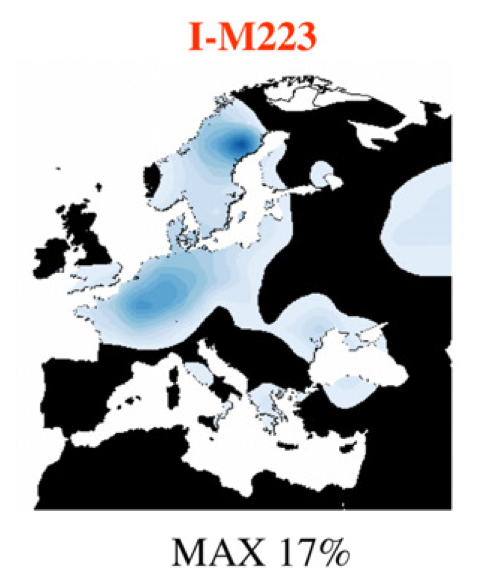
Balanovsky et al. 2008 tested for the SNP M223 and found it in several individuals from Russia.
Vologda (2/121=1.7%)
Unzha (2/52=3.8%)
Kashin (3/73=4.1%)
Livni (1/110=0.9%)
Belgorod (1/143=0.7%)
Kuban Cossacs (2/90=2.2%)
I am still collecting I2b1 data, I will update this post later today.
Edit:
In older publications M223 is also called I1c.
M223 frequency in Europe (From Table 1 in Rootsi et al., 2004):
Portuguese (5/303=1.6%)
Madeiran (Portugal) (2/132=1.5%)
Azorean (Portugal) (2/121=1.6%)
Cape Verde Islanders (1/201=0.5%)
Italian (northern Italy) (2/194=1.0%)
Italian (central Italy) (6/196=3.0%)
Italian (Calabria) (2/148=1.4%)
Italian (Albanese origin) (3/78=3.8%)
Italian (Sardinia) (2/142=1.4%)
French (Southern France) (1/38=5.3%)
French (Low Normandy) (1/42=4.8%)
French (Lyon, Poitier) (1/99=1.0%)
German (2/16=12.5%)
Dutch (3/30=10%)
Swedish (South Sweden) (6/168=3.6)
Norwegian (1/72=1.4%)
Estonian (1/210=0.5%)
Latvian (1/86=1.2%)
Polish (2/191=1.0%)
Czech and Slovak (2/198=1.0%)
Hungarian (2/162=1.2%)
Byelorussian (1/147=0.7%)
Ukrainian (3/585=0.5%)
Russian (Kostroma region) (2/53=3.7%)
Russian (Belgorod region) (1/144=0.7%)
Russian (Cossacks) (2/97=2.0%)
Russian (Adygea) (1/78=1.3%)
Mordvin (4/83=4.8%)
Chuvashes (2/80=2.5%)
Slovenian (1/55=1.8%)
Croat (mainland) (1/189=0.5%)
Albanian (4/106=3.8%)
Romanian (7/361=1.9%)
Moldavian (2/60=3.3%)
Gagauz (Moldova) (4/79=5.1%)
Greek (4/261=1.5%)
Turkey (5/741=0.7%)
Lebanese (1/66=1.5%)
The map based on Rootsi et al., 2004:

The number of tested Germans and Dutch is actually very low in this paper (N=16 and N=30, respectively), so the frequency in this region might be off.
The network of haplogroup I was obtained by using the biallelic markers and six STR loci (DYS19, DYS388, DYS390, DYS391, DYS392, and DYS393) in 533 Hg I chromosomes from 34 populations:

Interestingly, the Near Eastern STR haplotypes of I1c (M223) and I1a (M253) are both in the 'core' of their haplogroups, respectively.
It is also interesting to note that M223 is the one of the oldest SNPs in haplogroup I.

Subscribe to:
Posts (Atom)